FreeCryptoCurrency.Me

Free stocks and money too!

Author: samwsimpson_lyjt8578

FriesDAO raises $5.4 million with plan to buy fast food restaurants

A DAO aiming to buy fast food restaurants and give its community a say in how they’re run has raised $5.4 million in a crypto-backed foray into the world of hospitality. 

The group – dubbed FriesDAO – raised the funds over the week ended February 20 and has given out FRIES tokens to those who participated. These tokens will not confer any ownership of the restaurants or give holders any share of profits, but they will be used to vote on proposals with regards to how they operate.

Starting this week, token holders can stake their FRIES to receive KCHUP tokens, which can then be used to purchase NFTs. These NFTs will provide perks like free burgers.

The plan is to buy at least one fast food restaurant in the first year. If this doesn’t happen, the funds raised will be returned to the community, minus any expenses.

The first restaurant the DAO has mooted acquiring is a branch of sandwich chain Subway, according to a post in its Discord server. It has asked token holders to review the financial details ahead of a potential vote on the purchase.

The DAO began as a joke about how loss-making crypto investors can be forced to take jobs at restaurants like McDonald’s. Its Twitter profile says it’s “helping to provide jobs and food for ex-crypto traders by buying fast food stores around the world.”

According to a press release, the former president of Domino’s Pizza, Kory Spiroff, is an advisor to the project and the community includes several people with experience in the fast food industry.

What the DAO?

DAOs are the latest thing in crypto fundraising. Short for Decentralized Autonomous Organization, they’re supposed to be automated organizations completely run by code. However, in reality, many DAOs are largely run by a core team that implements decisions made by token holders, who vote on proposals with their tokens.

The first major example of a DAO was The DAO, which failed in 2016 due to a bug in its code. Then there was a revival of DAOs in early 2019, with Spankchain CEO Ameen Soleimani’s MolochDAO.

Recently there has been a big increase in the number of DAOs, from one that tried to buy a rare copy of the US Constitution, to NFT-collecting DAOs, to a DAO set up to help Ukrainian organizations that are suffering due to the recent Russian invasion.

© 2022 The Block Crypto, Inc. All Rights Reserved. This article is provided for informational purposes only. It is not offered or intended to be used as legal, tax, investment, financial, or other advice.

Go to Source
Author: Tim Copeland
Wintermute wins approval for UK’s crypto register as deadline approaches

Crypto market maker Wintermute has made it onto the UK Financial Conduct Authority’s (FCA) cryptoasset register.

Wintermute has significant heft within crypto markets, with a cumulative trading volume of $1.72 trillion since January 2020, according to its website. It offers more than 5,000 trading pairs. 

It has taken more than a year and a half of back and forth with the FCA to get the application — which covers the firm’s over-the-counter (OTC) spot business — approved.

“Wintermute has always held itself to the highest compliance standards and have built rigorous KYC-AML processes,” said the company’s chief operating officer Marina Gurevich. 

The approval comes as the fate of many firms’ UK operations hang in the balance. Earlier in February, 96 firms were awaiting decisions as to whether they would be admitted to the register before the March 31 deadline. The FCA currently has its work cut out processing approvals and rejections. 

Wintermute’s OTC spot business has grown considerably in recent years to provide prices across 250 tokens. The platform works with retail platforms, brokers, institutional investors, as well as blockchain projects, treasuries and “qualified investor” high net worth individuals.

Its OTC derivatives business is done from the business’s Asian hub in Singapore.

© 2022 The Block Crypto, Inc. All Rights Reserved. This article is provided for informational purposes only. It is not offered or intended to be used as legal, tax, investment, financial, or other advice.

Go to Source
Author: Lucy Harley-McKeown

Ukraine vice prime minister calls on crypto exchanges to freeze Russian accounts

Mykhailo Fedorov, vice prime minister and minister of digital transformation of Ukraine, has called on crypto exchanges to freeze the accounts of both Russian and Belarusian users.

Fedorov posted the plea on Twitter on February 27, following several days of intense fighting in Ukraine after Russian forces invaded the country late last week.

“I’m asking all major crypto exchanges to block addresses of Russian users,” Fedorov said. “It’s crucial to freeze not only the addresses linked to Russian and Belarusian politicians, but also to sabotage ordinary users.”

Jesse Powell, CEO of Kraken, one of the world’s largest exchanges, today responded that such a move could not be taken “without a legal requirement to do so,” but he added that Russian users should be aware that such an order “could be imminent.”

In a later tweet, Fedorov praised a move by NFT platform DMarket to freeze accounts belonging to customers in Russia and Belarus. DMarket had confirmed this on Twitter a few hours earlier, stating that assets remain in users’ accounts but that their access has been limited.

Fedorov’s plea comes days after the United States and European Union jointly moved to cut certain Russian banks out of SWIFT, the international payments messaging system, in addition to freezing the overseas assets of Russia’s central bank.

The Russian rouble has this morning plunged to a record low, sparking fears of a bank run in the country.  

Meanwhile, millions of dollars in bitcoin, ether and USDT have been donated to the Ukrainian government since its official Twitter account posted an appeal for support on February 26.

© 2022 The Block Crypto, Inc. All Rights Reserved. This article is provided for informational purposes only. It is not offered or intended to be used as legal, tax, investment, financial, or other advice.

Go to Source
Author: Ryan Weeks

Ukrainian government raises nearly $10 million in crypto following public appeal

Nearly $10 million bitcoin, ether and other digital assets has been raised since the Ukrainian government issued a direct appeal for crypto donations this weekend.

As previously reported by The Block, Ukraine’s official Twitter account, along with accounts owned by the country’s vice prime minister, posted donation addresses for BTC and ETH on Saturday, sparking a wave of interest and global headlines. 

At the time of writing, the Ethereum address has accrued $5.03 million in ETH as well as $1.3 million in other digital assets, with the bulk of the latter figure being comprised of about $1.07 million USDT. A number of NFTs have also been donated, per OpenSea data. 

The government’s bitcoin address has received some $3.5 million, a calculation that accounts for the roughly 3.658 BTC received to that address on February 24, prior to Saturday’s requests. 

The developments come as the invasion of Ukraine by Russia’s military continues. Recent updates include a potential plan between the two country’s leadership to meet and continued fighting in the Ukrainian capital of Kyiv.

© 2022 The Block Crypto, Inc. All Rights Reserved. This article is provided for informational purposes only. It is not offered or intended to be used as legal, tax, investment, financial, or other advice.

Go to Source
Author: Michael McSweeney

US, EU governments pledge to remove ‘selected’ Russian banks from SWIFT network

The United States and the European Union have announced a plan to cut out a group of as-yet-to-be-named Russian banks from the international payments messaging system SWIFT.

The group — comprised of “the European Commission, France, Germany, Italy, the United Kingdom, Canada, and the United States” according to a Saturday statement — announced the move after days of growing speculation that such a move was in play amid Russia’s invasion of Ukraine. In a sign of the fast-evolving situation, even two days ago sources were telling major newswires that such a move was unlikely. Yet reports in the past day highlighted the growing potential of retaliation in the form of SWIFT restrictions.  

The Society for Worldwide Interbank Financial Telecommunication, or SWIFT, is a messaging network for payment orders that connects thousands of financial institutions worldwide. According to a Friday report by Al Jazeera, more than 300 financial institutions in Russia are connected to SWIFT. 

In its statement, the group said that “we commit to ensuring that selected Russian banks are removed from the SWIFT messaging system. This will ensure that these banks are disconnected from the international financial system and harm their ability to operate globally.”

Additionally, the group pledged actions against the Russian central bank. “[W]e commit to imposing restrictive measures that will prevent the Russian Central Bank from deploying its international reserves in ways that undermine the impact of our sanctions.”

Other actions, including “measures to limit the sale of citizenship” to wealthy Russian citizens, were also promised.

The move comes as the fighting in Ukraine escalates, particularly in its capital city of Kyiv.

As The Block reported Saturday, the Ukrainian government has begun soliciting cryptocurrency donations to help fund its war effort. As of press time, the published donation addresses have accrued more than $4 million worth of bitcoin, ether and other Ethereum-based assets. 


© 2022 The Block Crypto, Inc. All Rights Reserved. This article is provided for informational purposes only. It is not offered or intended to be used as legal, tax, investment, financial, or other advice.

Go to Source
Author: Michael McSweeney

Ukraine’s official Twitter account posts pleas for crypto donations amid Russian invasion

Ukraine’s official Twitter account issued direct appeals for cryptocurrency donations on Saturday amid the ongoing invasion by Russian military forces.

As of press time, the official account, @Ukraine, has shared three such messages, though the first two were deleted. The addresses posted – for bitcoin as well as ether/USDT – remained consistent, though the wording of the appeals changed in each iteration. It is unclear whether the messages were purposefully deleted and reposted or if the inclusion of cryptocurrency addresses triggered controls put in place by Twitter following the 2020 account hacks.

The donation addresses were also shared by vice prime minister Mykhailo Fedorov’s verified Twitter account as well as in his verified Telegram channel.

When reached via a press contact email listed on its website, The Ukrainian Ministry of Digital Transformation, which Fedorov leads, told The Block that “the communications channels of the Ministry Of Digital Transformation of Ukraine and Minister Mykhailo Fedorov are secure. We are not hacked. This is [the] official position and messages we want to share.”

“We are trying to contribute to the Ukraine’s victory and raise the awareness of international society on what’s happening in Ukraine. In every possible way we can,” the representative continued.

Ukrainian diplomat Olexander Scherba also shared the Ukrainian account’s donation appeal.

Blockchain data indicates that the BTC address has garnered a total of 9.78612041 BTC as of press time, with the earliest transaction being posted on February 24.

Roughly 85 ETH has been sent to the listed address. Data from Etherscan indicates that donations have also been made in the form of USDT, USDC, as well as several non-fungible tokens.

Still, the messages have raised concerns about their veracity, especially given that the Russian military has conducted cyberattacks during its invasion. Among those expressing caution was Ethereum co-founder Vitalik Buterin, who urged people to avoid sending donations absent additional verification.

“There have been *a lot* of hacks alongside this invasion, this could easily be a hack,” Buterin wrote. “This info environment is as hostile as it gets, exercise extreme vigilance.”

Buterin later wrote that he was deleting his message, stating: “Getting some confirmations from a couple sources that it’s legit. Deleting my warning for now. But continue to be vigilant, and always be slow and careful when sending irreversible crypto transactions.”

Justin Sun, founder of Tron, wrote on Twitter that he spoke to the Ukrainian embassy of the World Trade Organization, claiming that the embassy confirmed the messages. 

Elliptic, the blockchain analytics firm that has been tracking donations amid the Ukrainian invasion, said Saturday that $5.1 million worth of crypto has been donated in recent days across nearly 3,000 donations.

When reached for comment about the donations, Elliptic co-founder Tom Robinson told The Block that some $200,00 worth of donations to the bitcoin address were sent to an exchange based in Ukraine. “It is a little suspicious that the funds are being moved to an exchange so quickly, but I haven’t been able to verify yet whether this is a genuine fundraising campaign,” he wrote.

The posts come as Russian invasion forces move closer to the Ukrainian capital of Kyiv. Reports also state that Ukraine’s president, Volodymyr Zelenskiy, has declined US offers to evacuate. 

Twitter did not immediately respond to a request for comment regarding the posts. 

© 2022 The Block Crypto, Inc. All Rights Reserved. This article is provided for informational purposes only. It is not offered or intended to be used as legal, tax, investment, financial, or other advice.

Go to Source
Author: Michael McSweeney

BitConnect founder indicted for alleged $2.4 billion Ponzi scheme

A federal grand jury has indicted BitConnect founder Satish Kumbhani with allegedly defrauding $2.4 billion through the crypto Ponzi scheme.

The US Department of Justice announced on Friday that a San Diego federal grand jury had charged Kumbhani with conspiracy to commit wire fraud, wire fraud, conspiracy to commit commodity price manipulation, operation of an unlicensed money transmitting business and conspiracy to commit international money laundering. 

Through BitConnect’s “Lending program,” Kumbhani and his co-conspirators allegedly defrauded investors out of $2.4 billion. According to the DOJ, BitConnect executives and promoters claimed the firm’s trading technology was a means to generate significant profits and guarantee returns for investors, but instead used the investments to pay earlier investors in a Ponzi scheme format. 

The indictment further alleges that Kumbhani directed a network of BitConnect promoters to pump the price of the firm’s BitConnect Coin, and also evaded US financial regulations to avoid scrutiny.

He faces a maximum of 70 years in prison if convicted of all charges. Kumbhani is an Indian citizen, and remains at large, according to the DOJ. 

Kumbhani separately faces a civil case lodged by the Securities and Exchange Commission (SEC), which the securities regulator filed in September of last year. The complaint alleges BitConnect’s lending program constituted a fraudulent and unregistered offering. It joined other cases against BitConnect representatives and promoters, some of which have already resulted in judgments compelling them to pay millions. 

Law enforcement has sought potential BitConnect victims in recent years as it builds a case against the firm’s executives and promoters. The FBI Cleveland Field Office and IRS Criminal Investigation division continues to investigate the case. Special Agent in Charge Eric Smith from the FBI’s Cleveland Field Office said the international aspects of the case won’t deter the FBI’s investigation.

“Today’s indictment reiterates the FBI’s commitment to identifying and addressing bad actors defrauding investors and sullying the ability of legitimate entrepreneurs to innovate within the emergent cryptocurrency space,” he said in a statement.

The DOJ encouraged any victims of the scheme to report their experiences.

© 2022 The Block Crypto, Inc. All Rights Reserved. This article is provided for informational purposes only. It is not offered or intended to be used as legal, tax, investment, financial, or other advice.

Go to Source
Author: Aislinn Keely

Deciphering the Metaverse: The rising tide of CC0

Quick Take

  • This weekly series explores the most interesting insights in NFTs, blockchain gaming, and virtual worlds
  • NFT traders and investors were fraught with trepidation, as a range of NFT marketplaces were hit with actual and perceived attacks
  • In the race for the most fruitful copyright strategy, CC0 projects are gaining momentum and are outperforming their more traditional counterparts

This research piece is available exclusively to
members of The Block Research.
You can continue reading
this Research content on The Block Research.

Go to Source
Author: Thomas Bialek

Here’s why calculating Coinbase’s revenue is trickier than just looking at public volumes

Coinbase caught many observers by surprise on Thursday when it revealed that it had exceeded Wall Street’s expectations for fourth-quarter revenue by nearly $500 million —  a sound beat by most standards.

It also left some scratching their heads. “I’m confused how they beat expectations by much, their volume is public,” Sam Bankman-Fried, chief executive officer of rival exchange FTX, tweeted.

Bankman-Fried’s question is a good one. Since more than 90% of Coinbase’s revenue comes from trading volumes, simply checking the data should theoretically give a good indication of the vast majority of the firm’s bottom line. But the reality is more complicated.

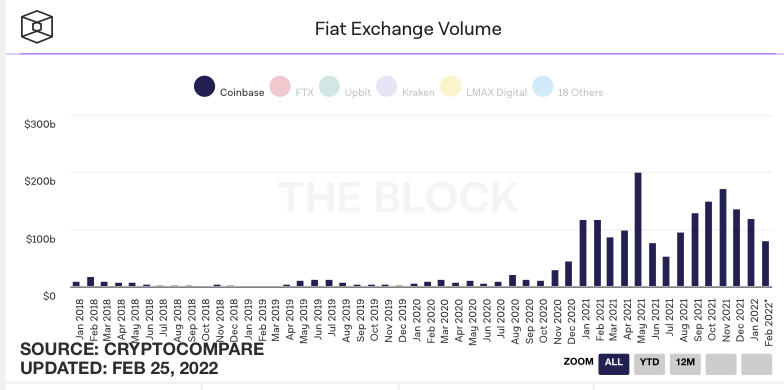
In the fourth quarter of 2021, the firm facilitated $459 billion in trading volumes, according to data from CryptoCompare. 

To figure out how much Coinbase made from that figure, multiply it by the so-called take rate, which is the average fee from a Coinbase trade. Over the last year, Coinbase’s take rate has hovered between 0.5% and 0.6%. 

Assuming a take rate of 0.5% and volumes of $459 billion (numbers via CryptoCompare), the exchange’s revenues hit $2.29 billion — which is much closer to Coinbase’s reported revenue of $2.5 billion than Wall Street’s expectation of $1.97 billion.

Still, there are some trading volumes that add another level of complexity to calculating Coinbase’s revenue.

Bankman-Fried is correct that Coinbase publicly releases data on volumes. But in fact, the firm does not release all of its volumes. While the lion’s share is made public via an API ($459 billion), that figure does not capture Coinbase’s total volume of $547 billion.

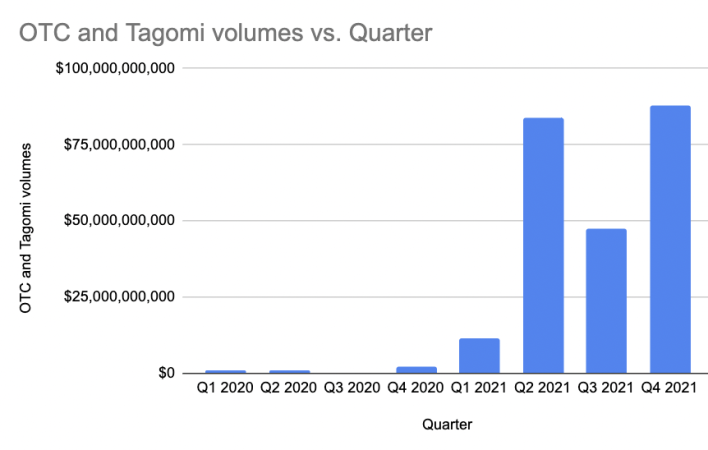
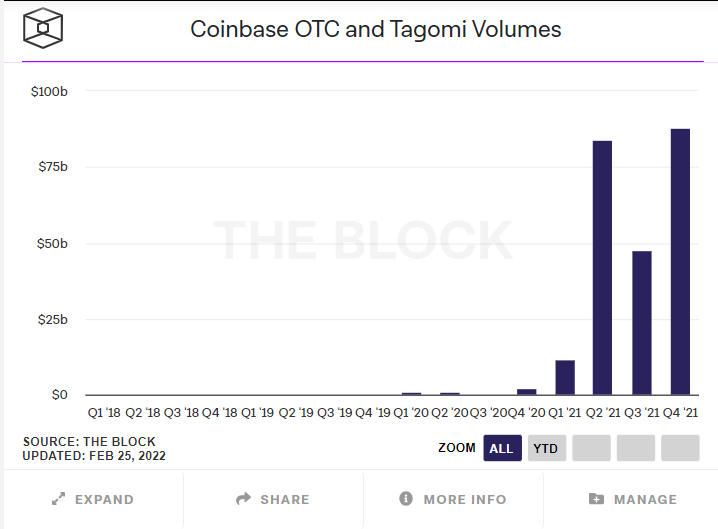
According to a spokesperson, the difference represents the volumes Coinbase brought in via institutional trading offerings: its over-the-counter trading desk and prime brokerage unit Tagomi. This quarter it amounted to $88 billion — an all-time high. 

That blind spot, combined in the disparity in the fees that retail traders pay versus what institutional ones pay, could explain how Wall Street came up short. 

According Will Nance, a Goldman Sachs research analyst focused on digital assets, the revenue expectation was low because Wall Street was expecting Coinbase to hit a lower take rate.

“The strong beat was driven by increases in retail volumes, with retail transaction revenue coming in ~36% above consensus estimates, while institutional trading revenues were ~11% below consensus estimates,” Nance wrote in a note to clients. “Take rate also increased by ~9bps sequentially, contributing to the revenue beat.” 

One analyst who asked to remain anonymous because their employer does not allow them to talk to the media told The Block that Wall Street thought fees would come in lower because they would be more dominated by institutional trading. The fees that large traders pay to use Coinbase are much lower than users of its retail brokerage. 

“If retail interest goes down, it’s their pro users that are more active on the platform and that’s where the fees trend lower,” the person said. 

But retail interest did not wane. In fact, surged by more than 90% quarter over quarter, contributing to a take rate of 0.54%.

John Todaro of Needham & Company said that the firm’s listing of Shiba might have contributed to the strong interest among retail clientele. 

“COIN’s weighted average retail fees rebounded from Q3 QoQ declines to 123 basis points from 109.9 basis points in Q3,” Todaro wrote in a note to clients. “We believe this rebound was in part driven by new retail users on to the platform, primarily looking to trade Shiba Inu, which saw heightened retail demand in Q4 ’21.”

Elsewhere, Coinbase saw its subscription revenue growth exceed Wall Street’s expectations by 21%. 

As for the first quarter of 2022, Wall Street might assume a higher take rate given guidance that the mix between retail and institutions will stabilize, as Nance notes.

“Lastly, the company noted that the mix of retail volume in 1Q had not changed significantly from 4Q, which we believe implies a more stable take rate in 1Q than investors were expecting,” he wrote. 

© 2022 The Block Crypto, Inc. All Rights Reserved. This article is provided for informational purposes only. It is not offered or intended to be used as legal, tax, investment, financial, or other advice.

Go to Source
Author: Frank Chaparro

Coinbase is clocking in record volumes via its prime brokerage service and over-the-counter trading desk

Coinbase is best known for its exchange business, but the firm’s less talked about operations in over-the-counter (OTC) trading and prime brokerage just had their best quarter ever, according to data analyzed by The Block. 

The Block estimates that OTC and prime brokerage volumes reached an all-time high of nearly $88 billion in the fourth quarter of 2021. That came during the same quarter that Coinbase also announced a full-scale launch of its prime business — a move that fully integrated brokerage firm Tagomi, which it acquired in 2020. 

The $87.9 billion figure represents the difference between the volume captured by public data sources like CryptoCompare last quarter and the total volumes Coinbase reported in its Q4 earnings report. Coinbase reported $547 billion in volume in its most recent earnings, while CryptoCompare only captured $459 billion for the same period. Coinbase confirmed the gap is filled by prime and OTC.

The growth in this number reflects the steady march of new institutional entrants to the crypto market. Trading OTC or via a prime brokerage provides institutions with a way to access deeper pools of liquidity without revealing their activity to the broader market.

In its Q4 earnings, Coinbase said that in 2021 its institutional customer base had by 50% relative to 2020 and that the firm had doubled the number of clients using its custody service.

© 2022 The Block Crypto, Inc. All Rights Reserved. This article is provided for informational purposes only. It is not offered or intended to be used as legal, tax, investment, financial, or other advice.

Go to Source
Author: Frank Chaparro


Follow by Email
Facebook20
Pinterest20
fb-share-icon
LinkedIn20
Share