FreeCryptoCurrency.Me

Free stocks and money too!

Author: samwsimpson_lyjt8578

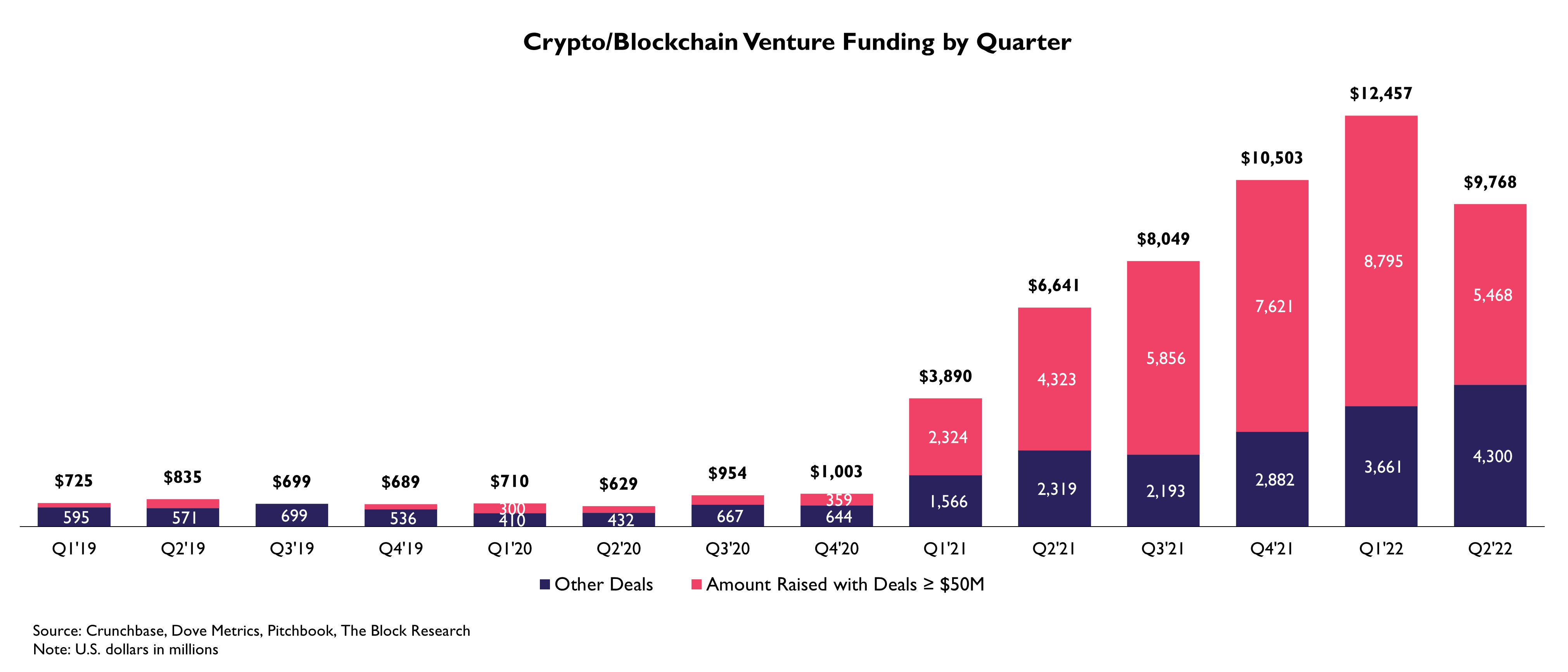
Blockchain venture funding declined roughly 22% in Q2

For the first time since 2020, venture funding in the blockchain sector took a dive this quarter — declining roughly 22% from $12.5 billion to $9.8 billion. 

That’s according to a new report from The Block Research, which shows that after seven consecutive quarters of growth, the impact of crypto’s recent downturn is beginning to show up in private funding.

The report also showed that while the total number of deals increased from 648 in Q1 to 694 in Q2, June was a particularly slow month — with a decrease from 247 to 196 month over month, a decline of almost 21%. 

Typically, private funding in the blockchain sector is a lagging indicator of the sector’s health because of the time discrepancy between when deals are announced and when they are made public. This means that venture funding may continue to decline as economic factors like rising inflation and crypto’s recent liquidity crisis continue to shape the sector.

According to the report, every subsector also experienced a decline in funding, except for data and analytics firms.

The portion of deals under $50 million also decreased: of the roughly $9.8 billion in funding this quarter, 44% came from raises smaller than $50 million, compared with 29% in Q1 2022.

© 2022 The Block Crypto, Inc. All Rights Reserved. This article is provided for informational purposes only. It is not offered or intended to be used as legal, tax, investment, financial, or other advice.

Go to Source
Author: Sam Venis

Celsius bankruptcy documents claim $1.2 billion balance sheet gap

Beleaguered crypto lender Celsius has claimed a $1.2 billion hole in its balance sheet, according to new documents filed as part of its newly declared Chapter 11 bankruptcy in New York.

Chapter 11 bankruptcy allows a company to continue operations while meeting its obligations to indebted parties. This is usually executed by proposing a plan of reorganization to be approved by creditors and overseen by a legal team.

The documents, filed on Thursday by CEO Alex Mashinsky and the company’s law firm Kirkland & Ellis, show that the official committee of unsecured creditors likely includes “mostly users.” The firm reported $5.5 billion in total liabilities and $4.3 billion in assets. 

Source: Mashinsky court filing

The company said has worked to “unwind” most of its open loans and cease asset deployment services until further notice before commencing with the filing of Chapter 11. It chose to do this due to the volatility of the crypto market. 

As of the petition date, the company has unwound nearly all of its DeFi loans and what it called “the FTX loan,” with only one loan remaining in an amount of approximately $3.2 million collateralized by $6.6 million in digital assets, it said. 

As of July 10, the company held 410,421 staked ETH (stETH), and as a result, approximately $467 million of the Company’s ETH, based on the market value of ETH, is illiquid, but is earning an approximate 5% APY pending the Merge, it added. 

The documents also state that on June 27, 2022, crypto hedge fund Three Arrows Capital (3AC) was ordered by a court in the British Virgin Islands to commence liquidation proceedings.

According to the filing, Celsius has a $40 million claim against 3AC, which, it said is “significantly less than the amount some other companies in the industry, such as Voyager, BlockFi and Blockchain.com, have against 3AC.”

Apart from its main business, Celsius also mines bitcoin through its subsidiary Celsius Mining, which took out up to $750 million in intercompany credit from Celsius. As of May 31, the outstanding balance on that loan was $576 million.

According to the document, Celsius believes that the mining operations will generate enough assets to pay off the loan and “provide revenue for the company in the future.” Celsius owns $720 million in “mining assets,” according to the document.

That side of the business is producing 14.2 BTC a day, which translates to around $292,520 based on bitcoin’s current price of around $20,600, according to TradingView.

The context

Founded in 2017 by Alex Mashinsky and Daniel Leon, Celsius offered retail investors attractive returns on their crypto holdings under the slogan “unbank yourself.” The company, which moved its headquarters from London to New Jersey last year, had grown to manage more than $10 billion in assets and claimed more than 1.7 million users. 

But this year’s crypto market slide left Celsius insolvent, and on June 12 it froze client withdrawals, transfers and swaps.

As The Block reported last month, Celsius’s lawyers had been pushing for it to enter Chapter 11 bankruptcy for a while — while the company’s executives attempted to avoid it at all costs. The firm had instead sought a show of support from app users to help win the internal argument.

Amid the tension, the Wall Street Journal reported this week that Celsius had replaced its legal advisers. 

Since halting withdrawals in June, Celsius’s woes have mounted — with state regulators in the US reportedly lining up to investigate its business practices.

This week, the Vermont Department of Financial Regulation said Celsius’s representations about the safety of customer funds were “untrue” and accused the company of engaging in an “unregistered securities offering” by offering cryptocurrency interest accounts to retail investors. 

The state of Celsius’s finances has scared off potential saviors. The Block reported last month that crypto exchange giant FTX looked at making a deal with the troubled firm but ultimately walked away after finding a $2 billion hole in its balance sheet.

© 2022 The Block Crypto, Inc. All Rights Reserved. This article is provided for informational purposes only. It is not offered or intended to be used as legal, tax, investment, financial, or other advice.
Go to Source
Author: Lucy Harley-McKeown and Catarina Moura

NFT marketplace OpenSea lays off about 20% of its team

OpenSea became the latest crypto firm to announce layoffs, with CEO Devin Finzer revealing that roughly 20% of the team is being let go.

In a statement posted to Twitter, CEO Devin Finzer wrote that “[t]oday is a hard day for OpenSea, as we’re letting go of ~20% of our team.”

“The changes we’re making today put us in a position to maintain multiple years of runway under various crypto winter scenarios (5 years at the current volume), and give us high confidence that we will only have to go through this process once,” the statement explained.

The exact number of employees impacted wasn’t disclosed; according to OpenSea’s LinkedIn profile, the firm has 769 employees. 

According to The Block’s Data Dashboard, volumes across NFT markets have fallen sharply since the highs seen earlier this year.

© 2022 The Block Crypto, Inc. All Rights Reserved. This article is provided for informational purposes only. It is not offered or intended to be used as legal, tax, investment, financial, or other advice.

Go to Source
Author: Michael McSweeney

MoonPay bolsters team with hires from Cisco, Cash App and Coinbase

Crypto payments and non-fungible token (NFT) service provider MoonPay said on Thursday it has brought in a tranche of top executives, a move that goes against the grain of current crypto market hiring trends. 

Asiff Hirji will be joining as advisor to the CEO following a stint as president of blockchain fintech company Figure. Hirji was Coinbase president and COO between 2017 and June 2019, according to his LinkedIn profile. 

Other big names include Akash Gang, a former VP of engineering at Block and CTO at Afterpay, as CTO; Jim Esposito, former head of operations at Block’s Cash App, as COO; Garrett McManus, previously head of artist development at CashApp, as head of marketing; and Abhay Mavalankar, former head of venture investments and M&A at Cisco Investments, as head of corporate development. 

Tom Capone, previously head of web3 at the Creative Artist Agency, will also join as head of MoonPay Studios – a new part of the company which will help ideate and incubate corporate ideas for NFT drops. 

MoonPay has moved to diversify its business model from its core product in recent months, which was originally a fiat to crypto onramping API.

In June, the company officially launched a utility NFT minting service called HyperMint. The platform allows brands and creators to mint up to 100 million NFTs at once. The move was part of an effort to manoeuvre into becoming an “Amazon Web Services for NFTs,” The Block first reported in April. 

MoonPay, which launched in 2019 to increase crypto adoption, closed a Series A funding round in November 2021 at $555 million, bringing the company’s valuation to $3.4 billion. 

The company’s hiring spree comes a tricky time for crypto. Market turmoil has prompted a series of layoffs in recent months by companies including Coinbase, BlockFi, Crypto.com, 2TM, Abra and Bitpanda.

© 2022 The Block Crypto, Inc. All Rights Reserved. This article is provided for informational purposes only. It is not offered or intended to be used as legal, tax, investment, financial, or other advice.

Go to Source
Author: Anushree Dave

JPMorgan analysts say bitcoin’s production cost has dropped to $13,000 — and price could follow

JPMorgan Chase analysts estimate that bitcoin’s production cost has dropped to about $13,000, which may imply further negative price movement. 

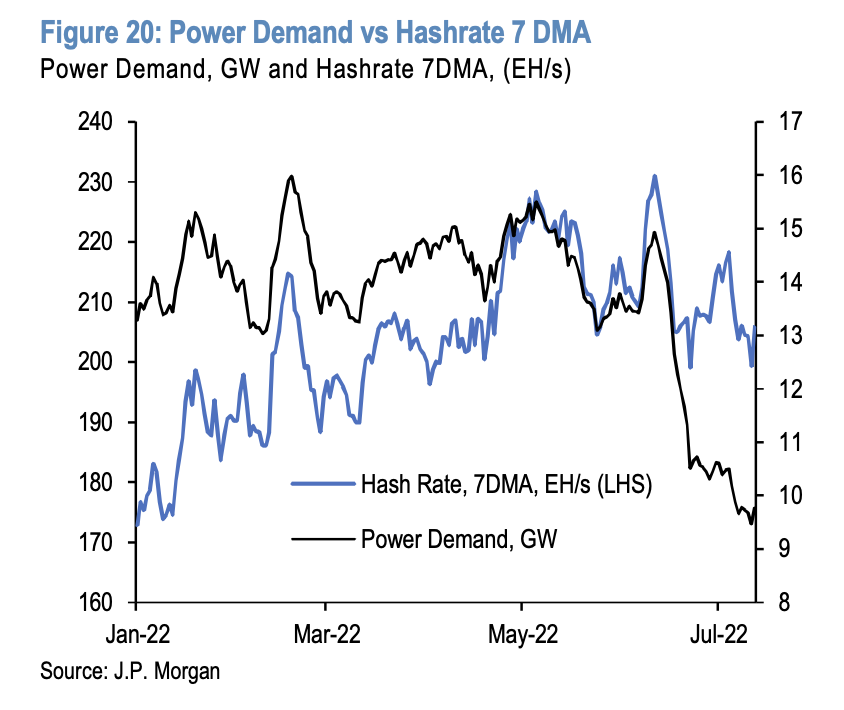
The investment bank estimated bitcoin’s average production cost was $20,000 at the beginning of June, dropping this to $15,000 by the end of the month and $13,000 as of Wednesday. Analysts have attributed the drop to the decline in electricity use. 

Thursday’s report said the “decline of the production cost estimate has been driven almost entirely by the decline in electricity use as proxied by the Cambridge Bitcoin Electricity Consumption Index (CBECI).” It went on to say that miners are making a strong effort to protect their profitability by deploying more efficient mining rigs instead of a mass exodus of less efficient miners.

In order to estimate a quantifiable production cost for bitcoin JPMorgan treats it as a commodity and bases it on the marginal cost of production. The marginal cost of production is estimated using daily price data, hash rate and difficulty from bitinfocharts.com, the bank said in a note on June 24. 

JPMorgan then uses the Cambridge Centre for Alternative Finance’s estimates for electricity consumption in the CBECI, and the hash rate to infer an implied efficiency estimate of mining hardware.

The report added that the decline in production cost could be perceived as negative for bitcoin’s price. During a bear market, the production cost is perceived by some market participants as the lower bound of the price range.

Bitcoin recently registered its worst quarterly decline in 11 years, dropping 56% during the second quarter of this year. Meanwhile, cryptocurrencies have fallen across the board, impacted by the collapse of the Terra blockchain in May and a liquidity crisis for crypto lending platforms in June.

Macroeconomic conditions continued to worsen throughout this period, with US inflation hitting a 40-year high on Wednesday, up 9.1% in June. Amid this ongoing turmoil, JPMorgan reported that its net income had dropped almost 30% during the year’s second quarter.

© 2022 The Block Crypto, Inc. All Rights Reserved. This article is provided for informational purposes only. It is not offered or intended to be used as legal, tax, investment, financial, or other advice.

Go to Source
Author: Adam Morgan McCarthy

CFTC flags 34 crypto and forex trading desks as unregistered foreign entities

The Commodity Futures Trading Commission  (CFTC) has expanded its RED List with a new roster of crypto and forex firms the agency has identified as unregistered foreign entities. 

The CFTC announced the 34 new additions on July 14, warning US users and financial service providers against accessing their services. 

Several of the entities announced share domain names or have domains that redirect to the same website. Others have websites that are themselves not live, including fx-cryptex.com and directcryptos.com. 

In a statement, Commissioner Kristin Johnson said: 

“In today’s global markets a foreign entity operating outside the United States may—with a few taps on a smartphone—reach potential US customers through email, text message, IM, chat app, or social media, and solicit them to invest, transfer, or deposit funds, or otherwise transact via platforms created and maintained outside of the United States.”

The firms make a total of 202 on the commission’s Registration Deficient List, an initiative launched in 2015 to flag foreign entities the CFTC suspects of acting as intermediaries within the US. Today’s announcement explains: “The Commodity Exchange Act generally requires intermediaries in the derivatives industry to register with the CFTC. An ‘intermediary’ is a person or firm that acts on behalf of another person in connection with trading futures, swaps, or options.”

The CFTC has been working to persuade Congress to give it more authority to regulate spot crypto markets. Although the commission has a registration regime for derivatives trading, it only has authorization to intervene in cash markets in the event of fraud or market manipulation. 

© 2022 The Block Crypto, Inc. All Rights Reserved. This article is provided for informational purposes only. It is not offered or intended to be used as legal, tax, investment, financial, or other advice.

Go to Source
Author: Kollen Post

A Look at DeFi Treasuries and Protocol Revenues

Quick Take

  • DeFi protocol treasury valuations across the board have fallen significantly along with the broader crypto markets during the ongoing downturn.
  • The reduction in treasury valuations could be attributed to the asset compositions, where native protocol tokens take up a large majority of treasury value and are subjected to volatile price swings.
  • Protocol revenues have been compressed due to weaker market sentiment and lowered interest in DeFi, as reflected in the 70% drawdown in total DeFi TVL.

This research piece is available exclusively to
members of The Block Research.
You can continue reading
this Research content on The Block Research.

Go to Source
Author: Alex Ho

NFT financing platform Supermojo raises $6 million in seed funding

Supermojo, a financing platform for non-fungible tokens (NFTs), announced Thursday that it raised $6 million in seed funding. 

The funding round was led by BH Digital, DRW Venture Capital, Intersection Growth Partners and Neuberger Berman, with additional participation from Sfermion, Arca, Gemini, Everyrealm, Arrington Capital, BlockFi Ventures, Circle Ventures, Crossbeam Venture Partners, Draper, FJ Labs, FBG Capital, OP Crypto, Red Beard Ventures and Ripple, according to a release shared with The Block.

Supermojo’s platform features a buy now pay later (BNLP) service for NFTs. BNPL a process in which a user pays a portion for a product outright and pays the rest in later installments, often with interest. 

“The NFT market needs to welcome new users in order to keep scaling. NFT marketplaces and storefronts have yet to offer the payment methods most people are familiar with when buying online,” said Supermojo CEO Amir Sarhangi in the statement, adding that BNLP is one familiar payment method for most users.

“Our team at Supermojo is committed to providing a more seamless, intuitive, and accessible NFT purchasing, financing, and custody experience for the next wave of NFT users, from checkout to resale,” Sarhangi said. 

BNLP became popular through traditional finance spaces via the company Klarna, but has crept into NFT financing as seen with the DeFi lender Teller recently launching NFT BNLP features.

Supermojo was founded by Sarhangi and Craig DeWitt, two former senior employees of distributed ledger startup Ripple.

© 2022 The Block Crypto, Inc. All Rights Reserved. This article is provided for informational purposes only. It is not offered or intended to be used as legal, tax, investment, financial, or other advice.

Go to Source
Author: MK Manoylov

NFT membership platform Hang raises $16 million Series A

Hang, a non-fungible token (NFT)-powered membership and loyalty rewards platform, has raised $16 million in a Series A round led by Paradigm. 

Additional investors included Tiger Global and founders of Allbirds, Warby Parker, Harry’s, Tiffany’s executive Alexandre Arnault, Kevin Durant’s Thirty Five Ventures, and Mr. Beast’s Night Ventures. 

The platform can be used by brands to launch NFT memberships for loyal customers. They can use these to unlock perks and benefits, and be part of a brand’s community long-term. 

Hang co-founder and CEO Matt Smolin told The Block that the company will use the fresh funds to expand product and engineering teams and build out its go-to-market team.

“It is easier than ever to create a brand today, which has led to so much competition in the fashion and greater apparel world, with acquisition costs skyrocketing. As such, it is more important than ever for these brands to offset the increased acquisition costs by increasing the lifetime value of their users,” said Smolin.

“The best way to do this is to build more loyalty into their businesses. Those brand executives see Hang as a radically differentiated solution from what is in the market and one that can finally align incentives between both brands and consumers.”

Since the pandemic has changed how people shop and connect to companies online, brands have been looking for new and better ways to acquire and engage customers. Acquiring and retaining new customers has also become more expensive, in part due to privacy policy changes from Apple and Meta. 

Smolin said he doesn’t foresee many challenges with onboarding customers onto an NFT-powered membership program, even if they’re not “crypto natives” or enthusiasts.

Currently, Hang works with Pinkberry, Budweiser, Bleacher Reporter and Superfly. 

“The companies we’re working with are globally recognized brands that have millions of customers,” he said. “I tell brands and CMOs all the time that the term ‘NFT’ may turn out to be superfluous in the future – we never say https anymore, this would be the same idea.”

© 2022 The Block Crypto, Inc. All Rights Reserved. This article is provided for informational purposes only. It is not offered or intended to be used as legal, tax, investment, financial, or other advice.

Go to Source
Author: Anushree Dave

CleanSpark doubles down on discounted bitcoin mining rigs

Bitcoin miner CleanSpark has acquired 1,061 rigs at a time when market prices are down.

The company added 1,061 Whatsminer M30S machines to its fleet, increasing its total hash rate by 93 petahashes per second (PH/s), according to a statement released Thursday.

As of June 30, CleanSpark had a total hash rate of 2.8 EH/s, which indicates the new machines represent roughly a 3% increase.

“We are seeing unprecedented opportunities in this market,” said Zach Bradford, CEO of CleanSpark. “We believe that our operational strategy focused on efficiency, up-time and execution will allow these metrics to continually improve.”

Last month, the company also announced that it has bought 1,800 Antminer
S19 XP bitcoin mining machines, at a total of 252 (PH/s).

CleanSpark said this week that the new machines were purchased at a “substantially discounted price compared to the spot market price from just a few months ago.”

Bradford described the current market as an “incredible market for builders.”

According to a recent operational update, CleanSpark increased its bitcoin production in June by almost 9% compared with the previous month, mining a total of 339 BTC.

The company sold almost all of it, bringing in around $8.4 million from the sale of 328 bitcoin.

© 2022 The Block Crypto, Inc. All Rights Reserved. This article is provided for informational purposes only. It is not offered or intended to be used as legal, tax, investment, financial, or other advice.

Go to Source
Author: Catarina Moura


Follow by Email
Facebook20
Pinterest20
fb-share-icon
LinkedIn20
Share