FreeCryptoCurrency.Me

Free stocks and money too!

Author: samwsimpson_lyjt8578

July NFT data wrap: Investor interest in gaming, NFTs continued despite market downturn

Declines in monthly NFT marketplace volume continued last month as the industry entered Q3 mired in the bear market.

But while retail may be down, there are signs from reports on Q2 investments that blockchain gaming and NFT projects were not as deeply affected by the downturn as other areas of crypto. 

Blockchain gaming dominates crypto venture market in Q2

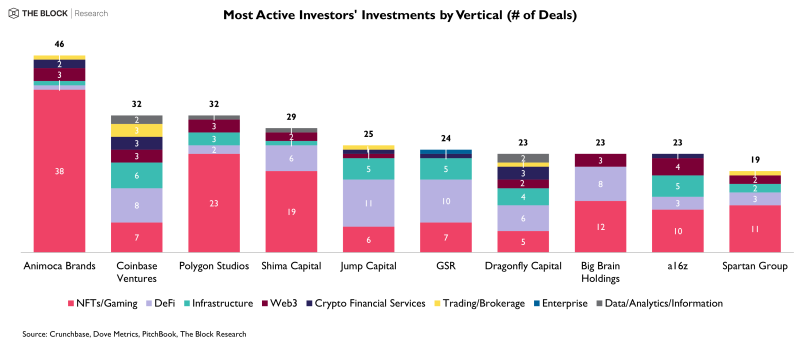
Interest among investors for gaming and NFT projects is not easing despite the market downturn, Blockchain gaming accounted for 47% of investments from the top 10 most active crypto investors — among them Coinbase Ventures, a16z and Dragonfly Capital — in Q2 of 2022.
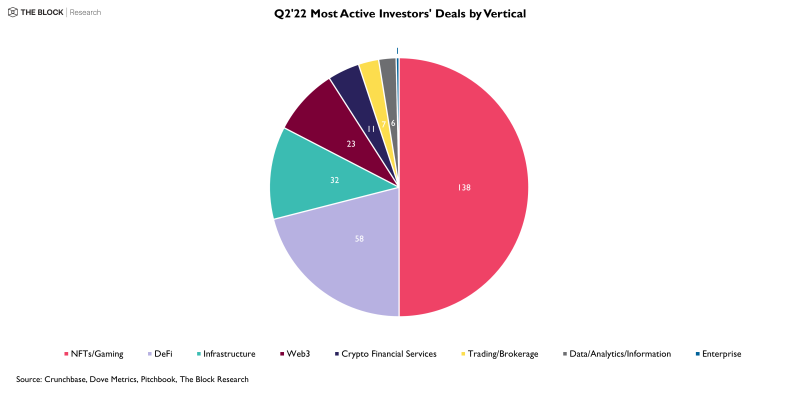
Out of 694 blockchain-related investment deals, 258 were related to NFTs and gaming, and represent a combined value of $2.6 billion, according to The Block Research.

“On average, NFTs/Gaming vertical proportionally take up almost half of all the most active deals, and, at least relatively, the interest in the blockchain gaming sector is not easing,” said The Block researcher Edvinas Rupkus.
Blockchain gaming accounts for 52% of all Unique Active Wallets

Gaming accounted for 1.1 million Unique Active Wallets (UAW), or 52%, in Q2, according to a July report from Dapp Radar.

Weekly NFT marketplace trading volumes remain low — with one exception

Monthly NFT marketplace volumes on Ethereum are down this month by 26% to a total of $678 million compared to last month’s $884.68 million in volume.

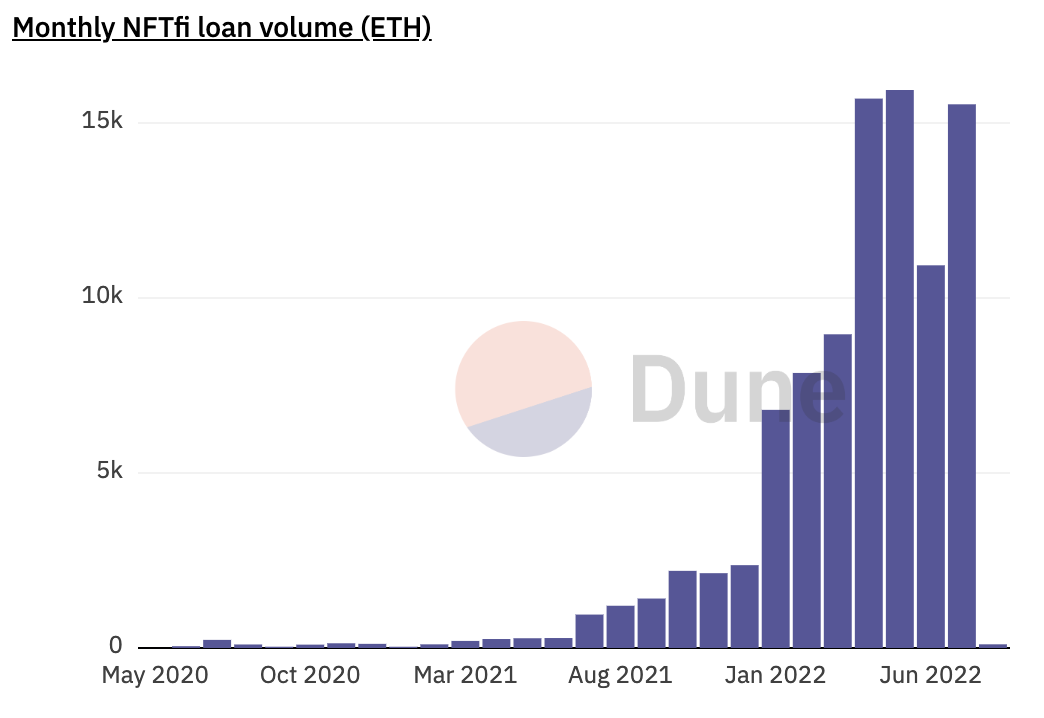
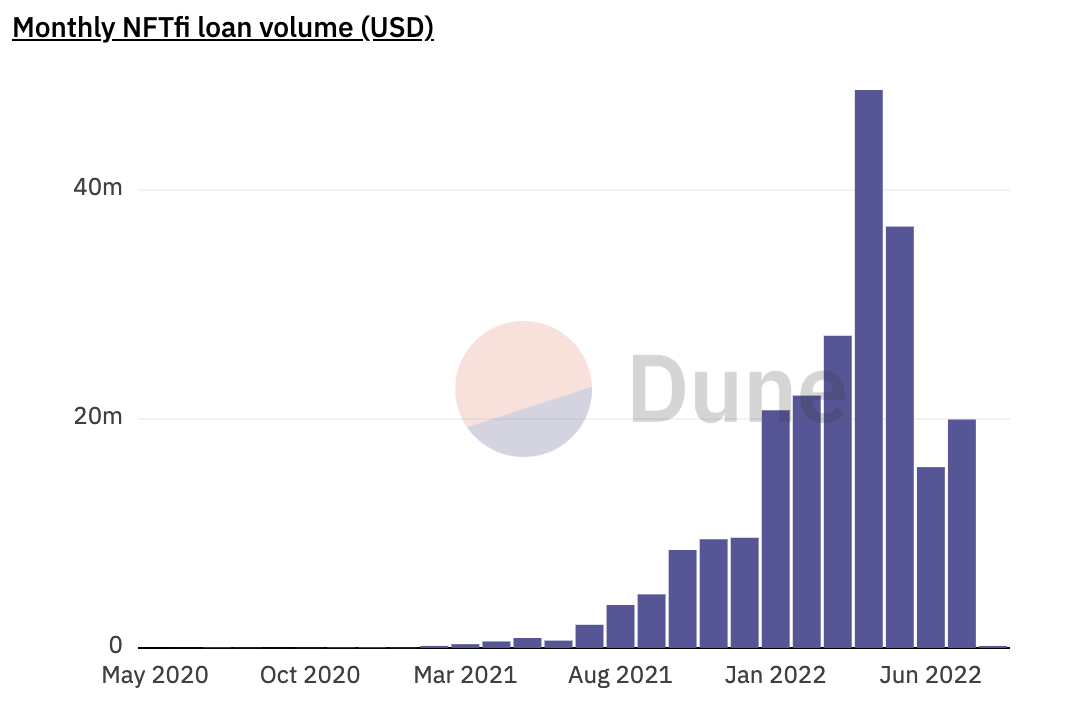
But NFTfi is bucking the trend, hitting nearly a record high in ETH volume last month. NFTfi offers lending in wETH of DAI through collateralizing NFTs from popular collections and doesn’t appear to have suffered so far in the recent NFT trading volumes collapse.
However, it should be noted things look a little different when the volume is shown in USD.
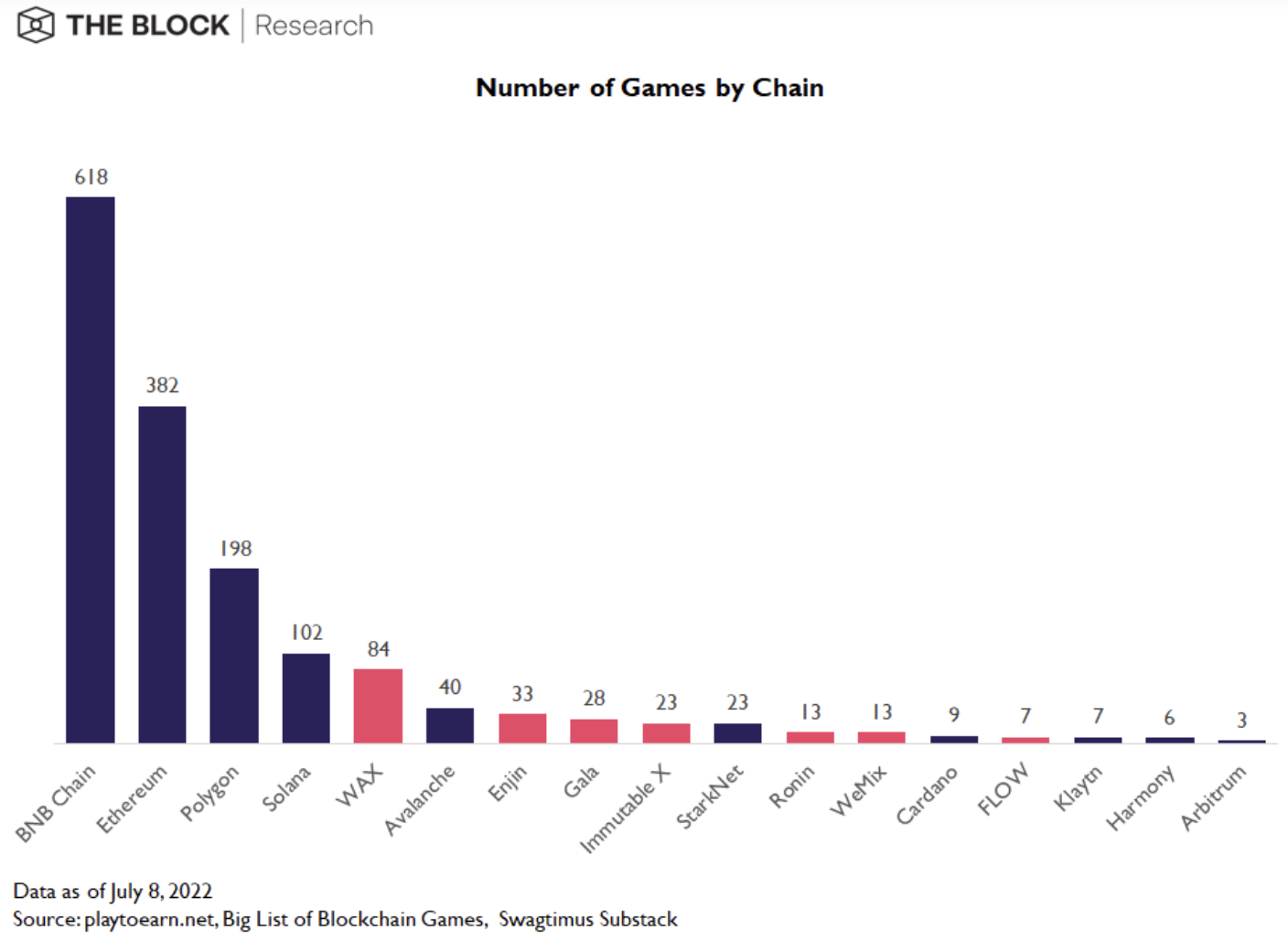
Layer-1s are battling to become the go-to gaming chain.

Layer-1s are competing to become the go-to gaming hub — and BNB Chain is in the lead by a long shot. Ethereum’s gas fee issues are causing the proliferation of more and more layer-1 chains offering NFT and gaming project-specific solutions.  
Splinterlands was the most played game of Q2

Splinterlands was the top game app of Q2 with 283k daily average unique active wallets, according to the Dapp Radar report. It is followed by Alien Worlds (188k), Farmers World (124k), Upland (45k), Axie Infinity (33k), Second Live (30k), Gameta (19k), MOBOX: NFT Gamer (19k), Mining Network (16k) and Pegaxy (16k).

However, Splinterlands is down 16% compared to last quarter, most likely due to the effect of reward structure changes including disincentivizing log-in rewards and overreliance on starter cards.

“These changes have flushed many low-effort participants and cut deep into the percentage of users who relied heavily on the free aspect of the game. The present community reflects the active player base for the dapp,” noted Dapp Radar.

The once-top blockchain game Axie Infinity is attempting to change its fortunes following the Ronin hack and the severe drop in its Smooth Love Potion token’s value earlier this year with the release of Axie: Origin and a complete revamp of the game.

Three in four US gamers associate the metaverse with Facebook/Meta

Facebook/Meta is still the primary association for the metaverse among many people, according to a survey of 1,000 US-based gamers by IT company Globant and YouGov.

When asked about companies associated with the metaverse, 73% named Facebook/Meta, 27% Epic Games and Fortnite, 21% Roblox, 15% The Sandbox, and 10% Niantic.

Just over half of the gamers believed the metaverse would change the video game industry and just four in 10 say the buzz around metaverse gaming is warranted.

And while advertisers and marketers are queuing up to partner with metaverse and NFT projects, potential players are less enthused. A total of 35% said they were comfortable with advertising in a metaverse space versus 40% who were uncomfortable with it. 

© 2022 The Block Crypto, Inc. All Rights Reserved. This article is provided for informational purposes only. It is not offered or intended to be used as legal, tax, investment, financial, or other advice.

Go to Source
Author: Callan Quinn

Bitcoin miner Bitfarms expanded power capacity to 166 megawatts in July

Bitcoin miner Bitfarms increased its energy capacity to 166 megawatts in July — up 21% from June 30 — after finishing the second phase of construction at one of its locations in Canada.

The company’s total hash rate also rose by 5.6% to 3.8 exahash per second (EH/s), according to a monthly update released Monday. The company expects to reach 4 EH/s by the end of this month.

Production also increased at two of the miner’s other sites in Canada and Washington State. However, it had to contend with the heat.

“Unseasonably high temperatures in Québec and Washington state late in the month also slightly lowered miner productivity and affected our corporate hashrate,” said Bitfarms’ Chief Mining Officer, Ben Gagnon.

The company mined 500 BTC in July, having sold 1,623 BTC throughout the month. Part of those revenues was used to reduce a bitcoin-backed loan by $15 million, bringing the outstanding debt to $23 million.

The miner has already sold 3,000 BTC in June to pay down part of a $100 million loan from Galaxy Digital.

Bitfarms held 2,021 BTC in custody as of July 31, after selling 1,623 BTC last month.

© 2022 The Block Crypto, Inc. All Rights Reserved. This article is provided for informational purposes only. It is not offered or intended to be used as legal, tax, investment, financial, or other advice.

Go to Source
Author: Catarina Moura

SEC charges Forsage founders, promoters in $300 million crypto Ponzi scheme lawsuit

On Monday, the Securities and Exchange Commission charged 11 people as part of an alleged $300 million global crypto pyramid and Ponzi scheme.

Retail investors were allegedly bilked by Forsage, which claims to be a decentralized smart contract platform, the SEC said. The four founders of the company, who were last known to be living in Russia, the Republic of Georgia, and Indonesia, were charged, as were three U.S.-based promoters who endorsed Forsage on its website and social media platforms. Several are members of the so-called Crypto Crusaders, a promotional group for the alleged scheme that operated in at least five U.S. states.

“As the complaint alleges, Forsage is a fraudulent pyramid scheme launched on a massive scale and aggressively marketed to investors,” said Carolyn Welshhans, acting chief of the SEC’s Crypto Assets and Cyber Unit.

Forsage could not be reached for comment.

Forsage was launched in January 2020 by Vladimir Okhotnikov, Jane Doe a/k/a Lola Ferrari, Mikhail Sergeev, and Sergey Maslakov, allowing retail investors to enter into transactions via smart contracts that operated on the Ethereum, Tron and Binance blockchains. The SEC complaint alleges that Forsage actually operated as a pyramid scheme with investors profiting by recruiting others into the scheme. They also allegedly used assets from new investors to pay earlier investors.

Two defendants who did not admit or deny the allegations agreed to settle the charges. Both settlements are subject to court approval.

Officials in the Philippines and Montana filed cease and desist orders against Forsage for operating as a fraud over the past two years to no effect. The defendants allegedly continued to promote the scheme while denying the claims in YouTube videos.

© 2022 The Block Crypto, Inc. All Rights Reserved. This article is provided for informational purposes only. It is not offered or intended to be used as legal, tax, investment, financial, or other advice.

Go to Source
Author: Christiana Sciaudone

Cboe reports $460 million write-down on ErisX acquisition

During its second-quarter earnings call on Friday, exchange operator Cboe reported a $460 million markdown on its recent purchase of ErisX, a crypto asset exchange acquired by the firm in May to help lead its reentry into the digital asset spot and derivatives markets.

Cboe also reported profits below Wall Street expectations, with rising compensation listed as a key factor in the missed targets.

The firm’s plans to acquire ErisX were announced on October 20, when the price of bitcoin was trading around $67,000. Since that time prices have dropped significantly, with the price of bitcoin currently hovering around $23,300.

On the results call, Cboe Global Markets chief executive Ed Tilly said since the closing of the ErisX transaction, the digital asset market environment had changed dramatically, which had led to the accounting adjustment.

Brian Schell, Cboe’s chief financial officer, said on the call that “we believe that our adjustment reflects the reality of the digital asset market environment today, but in no way changes our commitment to the digital asset space.” 

Despite the mark-down, Cboe reported rising revenue from options trading, futures trading, global foreign exchange trading, and North American and European equities.

The increase came from investors readjusting their portfolios to hedge against the recent economic downturn, which drove transaction volumes higher.

© 2022 The Block Crypto, Inc. All Rights Reserved. This article is provided for informational purposes only. It is not offered or intended to be used as legal, tax, investment, financial, or other advice.

Go to Source
Author: Sam Venis

Rage Trade: Capital Efficiency and Passive Liquidity for On-Chain Perps

Quick take

  • Liquidity for purely on-chain perpetual futures remains generally low.  
  • Composability of fully on-chain protocols offers competitive advantages, but this edge continues to be inaccessible at scale until liquidity grows.  
  • Rage Trade attempts to offer deep liquidity through passive vaults while preserving high capital efficiency for LPs.

This research piece is available exclusively to
members of The Block Research.
You can continue reading
this Research content on The Block Research.

Go to Source
Author: Afif Bandak

Aleo to test Virtual Machine ahead of mainnet launch

Layer 1 blockchain Aleo will launch the Aleo Virtual Machine (AVM), a computational platform to run privacy-focused apps on its network, as it looks to attract developers to its ecosystem. 

While Aleo is still in the testnet phase, next week it will introduce the AVM as part of its upcoming “testnet 3” launch scheduled between August and October. According to a note shared with The Block, the team sees the testnet as an opportunity to onboard new Aleo developers ahead of its mainnet launch in the fourth quarter of 2022. 

“Our focus is to build the absolute best developer framework for decentralized private applications,” Aleo co-founder and CEO Howard Wu said on the testnet 3 plan.

The testnet is incentivized and will reward developers with token incentives for running applications. Similarly, it will also allocate bounty rewards for bug hunters during the testnet period.

Aleo leverages zero-knowledge proofs, a cryptographic technology that can verify data while remains encrypted and hidden from the verifying party. Per the team, Aleo wants to offer applications in areas like payments, decentralized finance, identification management and gaming. 

In February 2022, Aleo raised $200 million in a Series B funding round co-led by SoftBank’s Vision Fund 2 and Kora Management.

© 2022 The Block Crypto, Inc. All Rights Reserved. This article is provided for informational purposes only. It is not offered or intended to be used as legal, tax, investment, financial, or other advice.

Go to Source
Author: Vishal Chawla

July by the numbers: A look at crypto exchange volumes, open interest, and miner revenue

Quick Take

  • Total adjusted on-chain volume decreased by 15.6%, to $416 billion.
  • A total of 63,254 Ethereum, equivalent to $83.7 million, was burned.
  • Monthly volume of NFT marketplaces on Ethereum decreased, by 26%, to $678 million.
  • Centralized exchange spot trading volumes increased by 0.6% to $632.7 billion.
  • FTX came in 2nd place for the third time in CEX spot trading volume, ahead of Coinbase, with a share of 9%.
  • The open interest in Ethereum options increased by 104.4% to $5.8 billion as the market is positioning for the upcoming ETH Merge.

This research piece is available exclusively to
members of The Block Research.
You can continue reading
this Research content on The Block Research.

Go to Source
Author: Lars Hoffmann

Europe dominates blockchain venture deals in Q2 as growth drops in Asia and the US

With venture funding for blockchain startups declining globally, crypto startup founders struggling to source funding might want to instead head to Europe, a region that’s bucking the trend.

Global blockchain venture funding plunged in the second quarter of this year — declining 22% from $12.5 billion raised in the first quarter to $9.8 billion in the second, according to a recent report from The Block Research. 

Meanwhile the amount raised by blockchain venture startups is up 25% in Europe compared to the previous quarter, according to The Block Research’s data. 

Africa is the only other region to see gains, with an increase of 189% from the first quarter to the second. Asia and the US saw declines of 43.4% and 23.8%, respectively. 

Europe’s recent gains mean it surpassed Asia by a slim margin for second position in terms of global share of blockchain venture funding raised. The US remained in the top spot with a total of $5.4 billion raised, compared to Europe’s $1.8 billion. 

Amount raised by continent in the second quarter from The Block Research

Amount raised by continent in the second quarter from The Block Research

Some of the most active investors for European projects were Animoca Brands, Coinbase Ventures, GSR, Polygon Studios and Jump Capital, per The Block Research.

The global decline in funding is the first in blockchain venture funding since 2020. Previously there had been seven consecutive quarters of growth. 

Private funding is typically seen as a lagging indicator of the crypto sector’s health as there is a time delay between when deals are made and publicly announced.  

Venture funding could continue to decline as investors grapple with macroeconomic issues like rising interest rates and inflation, as well as the fallout from the bankruptcies of key industry players like Voyager and Celsius. 

The recent turmoil in crypto markets, however, has also spurred mergers and acquisitions, which is another bright spot in the second quarter data. The Block Research’s recent report shows that M&A transactions are on pace for a record year. 

Last year, 204 M&A transactions took place. Drawing on data from the first half of this year, M&A deals are on track to hit 212 this year. 

Since the private markets have started to cool off, M&A activity within the sector will be worth following over the next few quarters,” said John Dantoni, a researcher at The Block research, in the report. 

“The valuations for private firms have been and will likely continue to re-adjust to the current market environment,” he added. “As a result, we expect to see M&A activity increase, particularly by larger firms in the industry.” 

© 2022 The Block Crypto, Inc. All Rights Reserved. This article is provided for informational purposes only. It is not offered or intended to be used as legal, tax, investment, financial, or other advice.

Go to Source
Author: Kari McMahon

Vauld gets three-month moratorium extension to continue exploring options

Embattled Asian crypto lender Vauld, which abruptly halted client withdrawals last month and sought protection from creditors, has received three months to continue exploring its options, two sources with direct knowledge of the matter told The Block.

The Singapore High Court granted Vauld a moratorium extension until November 7 at a hearing today, the sources said. The court has also asked Vauld to form a creditors committee, they added.

Vauld had been seeking a six-month extension under a moratorium application filed on July 8. The three-month extension means disgruntled creditors of Vauld cannot commence or continue any legal proceedings against the company while it explores its restructuring options. Client funds remain stuck until Vauld reaches a restructuring deal, including its potential acquisition by rival Nexo.

Vauld did not respond to The Block’s request for comment by press time.

Vauld woes 

Vauld halted client withdrawals on July 4 after facing financial difficulties caused by TerraUSD’s (UST’s) implosion and the broader crypto market downturn. The firm, based in Singapore with most of its team in India, owes a total of $402 million to its creditors. Of that sum, $363 million — or 90% — comes from individual retail investors’ deposits.

The moratorium extension had support from many of Vauld’s creditors. As The Block reported last week, from the total of around 147,000 creditors, 2,910 responded to its moratorium application, with 2,280 (approximately 78%) indicating that they are in support of the extension.

London-based Nexo is currently exclusively conducting due diligence on Vauld. It started the process on July 5 and has until September 5 to reach a decision on whether to bail out Vauld.

If Nexo decides to not make a deal with Vauld, the latter could take other paths it has previously highlighted. These include raising more venture capital, converting debt to equity, issuing its own token and developing a payment plan tied to future revenue.

© 2022 The Block Crypto, Inc. All Rights Reserved. This article is provided for informational purposes only. It is not offered or intended to be used as legal, tax, investment, financial, or other advice.

Go to Source
Author: Yogita Khatri

As the Ethereum merge approaches, a key miner is pushing a proof-of-work fork

As Ethereum inches closer to its switch to proof-of-stake consensus — the long-awaited shift known as “the merge” — the community is facing the possibility of a miner-led fork that will split the network.

The idea has gained fresh impetus after Chandler Guo, an influential Chinese crypto miner and investor, declared on Twitter last week he would fork the Ethereum blockchain to what he called “ETH POW,” allowing miners to continue operations after the merge.  

The merge — which is planned for the coming months — will transition Ethereum from proof-of-work (PoW) consensus to proof-of-stake (PoS). That will remove the need for transactions to be verified by miners, who have spent billions of dollars buying graphical processing unit (GPU) chips to mine new blocks. 

Because of this, Ethereum developers have long anticipated that the merge would be unpopular with miners and made arrangements to counter their interference — including a “difficulty bomb” that will make it significantly harder to mine new blocks.

But while miners can’t stop the merge, they can clone Ethereum and create their own version of the network where the transition never takes place. The question is whether they can attract anyone to use their forked version.

Guo has form here. He was involved in forking Ethereum in July 2016, which resulted in the formation of Ethereum Classic. Now Guo wants to repeat the feat by acquiring enough hash power — a measure of  crypto mining output — and convincing other miners to join him.

“I fork Ethereum once, I will fork it again,” Guo wrote in a post last week.

If he’s successful, the Ethereum network will split into two chains: the non-canonical PoW version operated by the miners and the default PoS chain run by Ethereum core developers and validators.

Ether holders would receive tokens on the new chain as the network is copied, albeit at a much different price. As forked POW ETH comes into existence, its native asset will have to be freshly listed on crypto exchanges and experience new price discovery — with no guarantee the forked tokens will have any value.

Start afresh

While the forked chain would be free to continue with PoW consensus, it won’t necessarily bring along any of the ecosystem of apps and developers that give value to the Ethereum mainnet and its ether token. Development would have to start from scratch on ETH POW, with smart contracts freshly deployed and maintained.

Furthermore, the forked PoW chain will lack critical assets like stablecoins needed to support functioning decentralized finance apps. This is likely to make the forked network less appealing to users, unless stablecoin firms decide to add support. In this regard, Paolo Ardoino, chief technology officer of the body behind the tether stablecoin, clarified in a Twitter post on Sunday that it would support the PoS version over the proposed PoW fork.

A fork is not the only option left for miners. There have also been talks about migration to Ethereum Classic, which will continue to use PoW consensus even after the main Ethereum network switches to PoS. AntPool, a pool operated by mining giant Bitmain, has signaled support for Ethereum Classic and made a $10 million investment in its ecosystem.

© 2022 The Block Crypto, Inc. All Rights Reserved. This article is provided for informational purposes only. It is not offered or intended to be used as legal, tax, investment, financial, or other advice.

Go to Source
Author: Vishal Chawla


Follow by Email
Facebook20
Pinterest20
fb-share-icon
LinkedIn20
Share