FreeCryptoCurrency.Me

Free stocks and money too!

Author: samwsimpson_lyjt8578

Treasury sanctions on Tornado Cash extend far beyond the US

On Monday, the US Treasury’s Office of Foreign Asset Control (OFAC) designated Tornado Cash as well as an ecosystem of linked wallets, saying that bad actors including North Korea’s Lazarus group had used the platform to launder more than $7 billion. The project’s co-founder saw his account on open-source code repository GitHub taken down, and users of the mixer had their funds locked. 

There has subsequently been an outcry from the crypto community, which has been mourning the loss of the platform. Leading crypto figures such as Vitalik Buterin came forward about using Tornado Cash for good causes.

Others have minimized the impact of US sanctions designations, particularly for people outside of the country.  

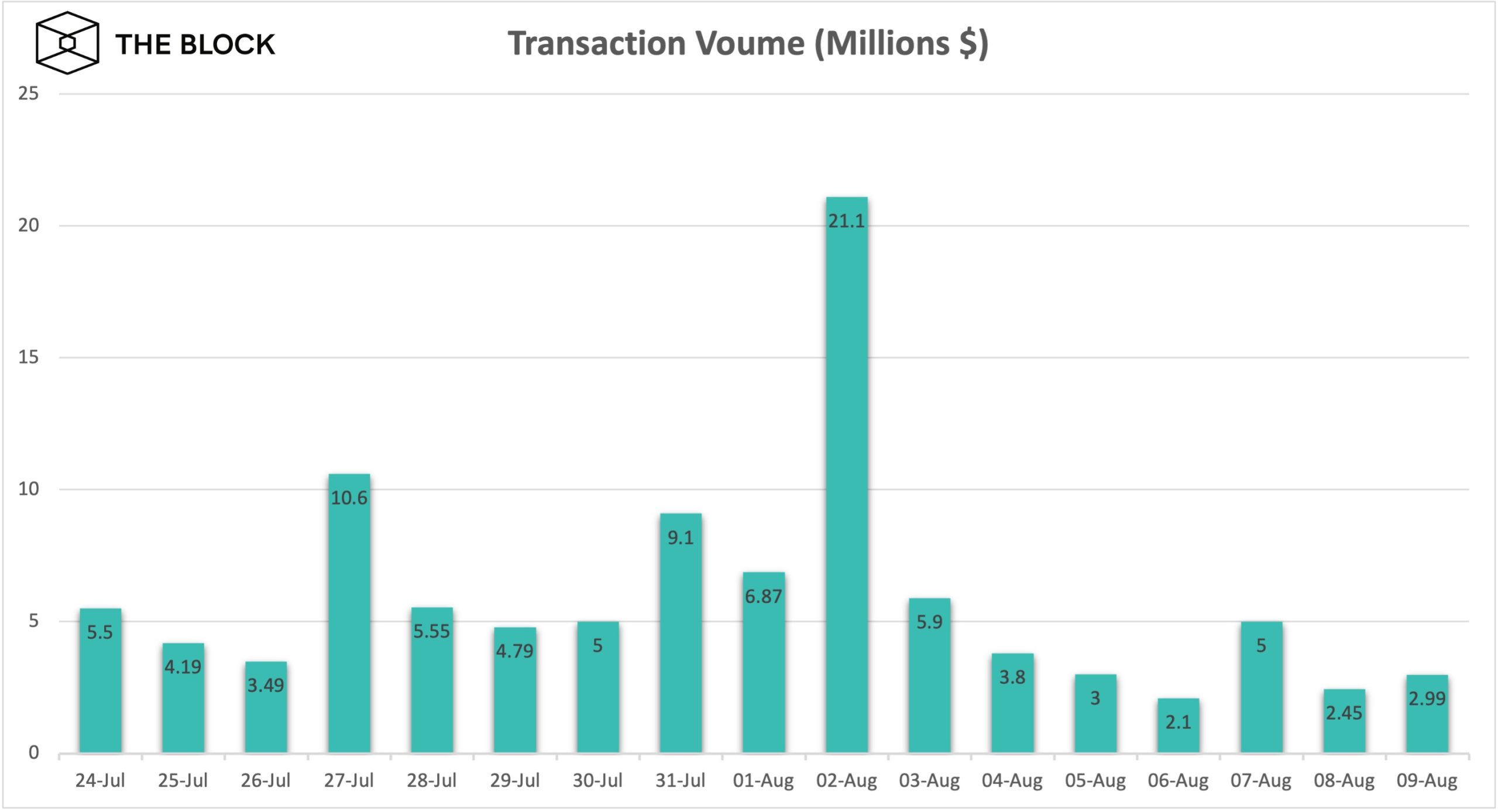
For the time being, the amount of crypto in Tornado Cash’s privacy pool has not yet dropped precipitously. A bot that tracks the mixer’s 24-hour transaction volume found it had processed nearly $3 million in transactions in the day following the OFAC announcement.  

But, long term, these arguments underestimate the scope of US jurisdictions — especially when it comes to global financial institutions. The reality is that most of the crypto going through the protocol is destined for conversion back into fiat before it is spent. The US plays a central role in that process globally. It’s the same reason that the US sanctions regime is such a powerful tool in traditional finance.

In the absence of secondary sanctions, it’s true that non-US entities are broadly speaking still allowed to transact. But financial intermediaries around the world — the ones non-US Tornado Cash users will need in order to cash out — will now see these transactions as risky. As those entities back away, it’s likely that Tornado Cash will lose much of its liquidity.

Moreover, it’s not just legitimate institutions that want to avoid OFAC-designated entities.

“Even if you’re an illicit actor, you don’t want to put your money somewhere the US government is shining a light,” said Ari Redbord, a former advisor at the Treasury’s office of terrorism and financial intelligence who now leads the legal team at blockchain analytics firm TRM Labs.

The involvement of North Korea’s Lazarus group in this case effectively damns any project associated with Tornado Cash, as the national security apparatus is significantly more aggressive than any US financial regulator. 

“It was really bad when we thought hackers attacked Ronin,” said Redbord, referring to the recent theft of nearly $600 million from the network underlying the game Axie Infinity. “It became a national security issue when we learned that it was North Korea.” 

While sanctions explicitly criminalize US persons or US-based entities from interacting with Tornado Cash or the designated associated wallets, their applications are significantly broader. 

“Even if you are not a US person, cashing out funds from Tornado Cash at a compliant cryptocurrency service subject to US jurisdiction could still trigger a violation,” wrote Andrew Fiernan, head of sanctions strategy at Chainalysis.

Sanctioning a smart contract

Some, such as Coin Center’s Peter Van Valkenburgh, argued that OFAC had overstepped its authority by designating an “entity” that is actually a smart contract. Typically, a legal entity is either an individual or a corporation, which gives it the right to, among other things, own property, open bank accounts and get representation in court. Tornado Cash can do none of these things. Most importantly, that means it cannot fight against its own designation. 

The smart contract itself can still function — a mirror site is, in fact, already live. But the privatization features of Tornado Cash depend on having a sufficient user base. With the US Treasury having established an aggressive posture towards any new mixer that would take Tornado Cash’s place, it’s hard to picture one growing to the same scale as Tornado Cash — especially if state actors like the Lazarus Group begin using it — without encountering a similar OFAC action. 

From its experience with traditional financial investigations and sanctions, OFAC is already familiar with the whack-a-mole game of finding shell companies and related individuals holding assets for designated actors. With more tools to trace crypto, the Treasury seems set on taking that similar approach to digital finance. 

Roman Semenov, a co-founder of Tornado Cash, did not return a request for comment as of publication time.

© 2022 The Block Crypto, Inc. All Rights Reserved. This article is provided for informational purposes only. It is not offered or intended to be used as legal, tax, investment, financial, or other advice.

Go to Source
Author: Kollen Post
Despite sanctions, crypto traders are still using Tornado Cash

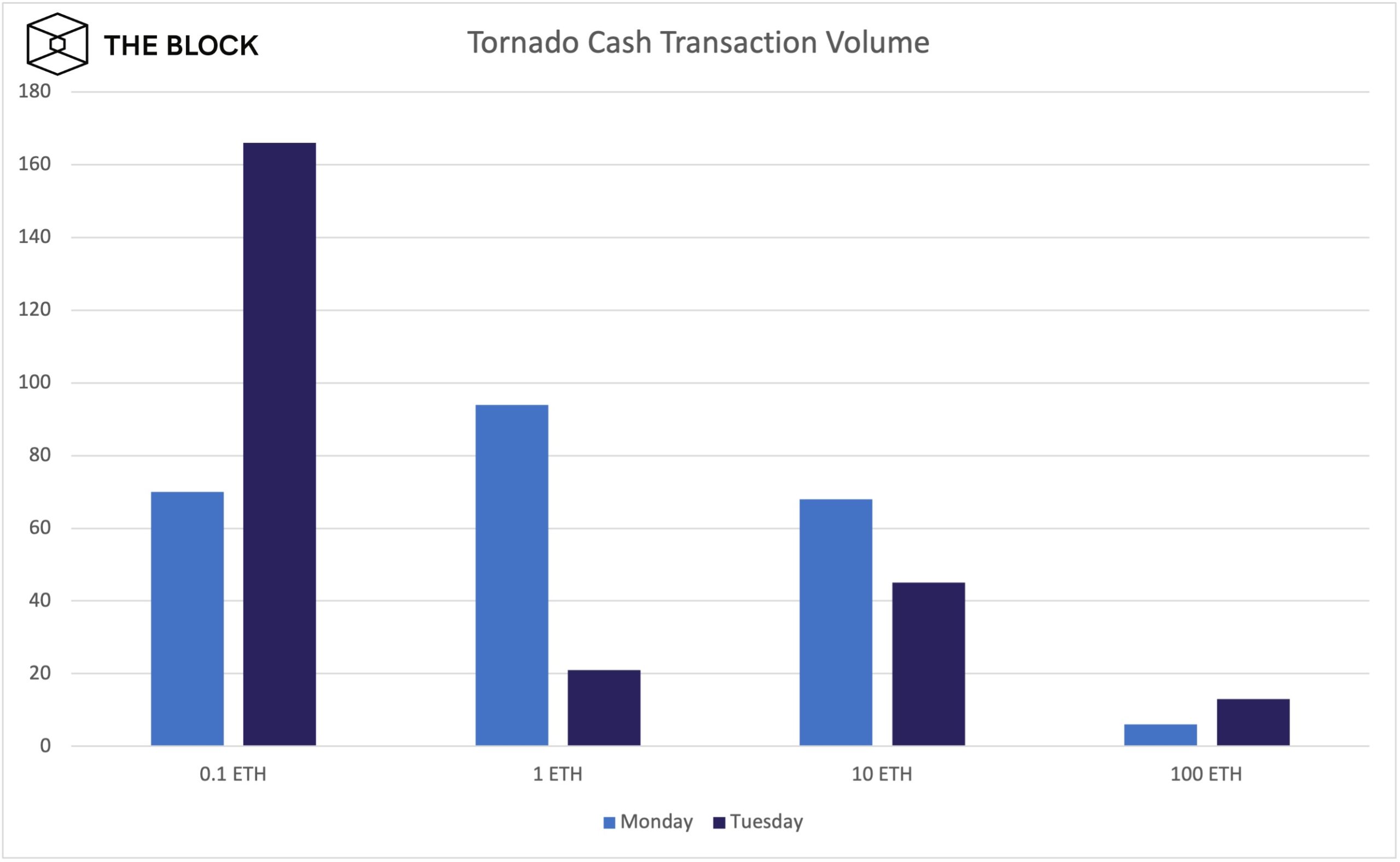
Transaction activity on Tornado Cash increased between Monday and Tuesday despite US government sanctions 

On Monday, the US Treasury sanctioned the cryptocurrency mixing service, which allows users to obscure their transaction history. Tornado Cash and 44 associated Ethereum and USDC wallets were add to the Treasury’s Specially Designated Nationals (SDN) list.

The SDN list prohibits US persons and firms looking to operate in the US from making financial interactions with designated entities. In spite of this, users have continued to use the platform, as transaction volume increased between Monday and Tuesday (although remained lower than on previous days).  

On Monday, transaction volumes on Tornado Cash reached $2.45 million with most transactions involving 1 or more ether (ETH). Transaction volume climbed to $2.99 million on Tuesday, as more users sent amounts of 0.1 ether through the smart contract. Mixing services split up amounts of cryptocurrency into specific accounts, making it easier to mix all the money around without leaving a trail.

The increase in smaller transactions may be linked to a protest over sanctions involving a user sending small amounts of ether to well-known crypto individuals and celebrities. Those targeted by the wallet dusting on Tuesday included names like Coinbase CEO Brian Armstrong, late-night TV’s Jimmy Fallon, YouTuber Logan Paul and basketball star Shaq. 

Beyond the Ethereum wallet dusting, larger transactions also saw a significant uptick in volume, with 100 ether transactions increasing from six on Monday to thirteen on Tuesday. 

© 2022 The Block Crypto, Inc. All Rights Reserved. This article is provided for informational purposes only. It is not offered or intended to be used as legal, tax, investment, financial, or other advice.

Go to Source
Author: Adam Morgan McCarthy

Ether price heads toward $2,000 on back of CPI update

The price of ether has closed the distance to the $2,000 mark on Wednesday, as US inflation came in below expectations.

At the time of writing, ether was trading at $1,841, up 8% over the past 24 hours. This puts ether at a price not seen since last June and shows that it has retraced one of its large drops in price.

Ether’s price action on Wednesday comes after US inflation came in below expectations, unchanged from June and up 8.5% year-on-year (below expectations of 8.7%).

Matt Weller, global head of research at Forex.com told The Block that today’s “softer-than-expected inflation report might help reduce the headwind of rising US interest rates for Ethereum and other crypto assets,” before adding that the Fed will want to see a “sustained trend of falling inflation before even considering a pivot to reducing interest rates.”

Weller concluding that, “regardless of how smoothly next month’s merge is, the expected 0% inflation rate of ether supply will be very attractive relative to the 8% – or more – inflation rate of the US dollar.”

BlockFi’s daily trading update echoed Weller’s sentiment, adding “attention will now likely be turned toward the Fed and whether they deem inflation to be problematic enough to approve another 75 bps rate hike.”

Another factor impacting ether’s price on Wednesday was the Goerli merge – which is the last testnet merge before the Ethereum blockchain moves from a proof-of-work to a proof-of-stake consensus mechanism in September. The Goerli merge is expected to take place early morning UTC on August 11.

© 2022 The Block Crypto, Inc. All Rights Reserved. This article is provided for informational purposes only. It is not offered or intended to be used as legal, tax, investment, financial, or other advice.

Go to Source
Author: Adam Morgan McCarthy

Crypto exchange Hotbit suspends trading and withdrawals amid criminal investigation into former employee

Crypto exchange Hotbit has announced a suspension of trading, deposit, withdrawal and funding functions as of 10 a.m. ET on Wednesday. 

The suspension comes amid an ongoing investigation into a former management employee’s involvement in a project in 2021, that is alleged of violating criminal laws, according to an announcement posted on the company’s website.

Hotbit did not reveal information about the investigation or the identity of the employee, only saying that they “left Hotbit in April this year.” 

It also said that several senior managers have been subpoenaed by law enforcement since the end of July and are assisting in the investigation. 

Hotbit said in the blog post that the company and other employees did not have knowledge about and were not involved in the project in question. 

 “Law enforcement has frozen some funds of Hotbit, which has prevented Hotbit from running normally,” the firm wrote, adding that the assets and data of all users are safe. Hotbit said that it has applied to the law enforcement to release the frozen assets. 

It did not detail which jurisdiction the investigation is being carried out in. 

According a separate announcement, the Shanghai and Taipei-based exchange will cancel open order during the suspension. It will also forcibly liquidate all users’ leveraged exchange-traded fund (ETF) positions by 12 p.m. UTC on Wednesday to prevent the loss by holding the positions. Despite the suspension, Hotbit is still distributing the income of investment products to users. 

Hotbit was founded in 2018 and registered in Hong Kong and Estonia. According to the firm’s website, it has more than 1 million registered users from more than 170 countries.

© 2022 The Block Crypto, Inc. All Rights Reserved. This article is provided for informational purposes only. It is not offered or intended to be used as legal, tax, investment, financial, or other advice.

Go to Source
Author: Kharishar Kahfi

SEC, CFTC consider new crypto reporting rule for large hedge funds

Hedge funds would be required to report cryptocurrency exposure through a confidential filing under a new joint proposal considered by the Securities and Exchange Commission and the Commodity Futures Trading Commission.

The commissions want to learn more about the risks that cryptocurrency poses to the US economy, especially after the market crash this summer. The proposal was first reported by the Wall Street Journal

Under the proposed rule, hedge funds with more than $500 million of net assets would report cryptocurrency exposure using Form PF, a confidential filing created after the 2008 financial crash. The funds would also need to report information about their portfolio concentrations and borrowing arrangements. The SEC considered amendments to Form PF during an open meeting on Wednesday. 

Federal agencies use reported data to publish statistics about the private funds industry.

“I’m pleased to support the proposal because if adopted I think it would improve the quality of information we receive from all form PF filers, with particular focus on the large hedge fund advisers,” SEC Chair Gary Gensler said during the commission meeting. 

An SEC fact sheet on the proposed Form PF amendments says that they “are designed to enhance FSOC’s [Financial Stability Oversight Council] ability to monitor systemic risk and bolster the SEC’s regulatory oversight of private fund advisers.” The number of private funds increased by nearly 55 percent between 2008 and the third quarter of 2021, according to the fact sheet.

“You have this private fund space growing more rapidly, and less transparently,” Gensler said. 

© 2022 The Block Crypto, Inc. All Rights Reserved. This article is provided for informational purposes only. It is not offered or intended to be used as legal, tax, investment, financial, or other advice.

Go to Source
Author: Stephanie Murray

A Framework for Blockchain Modularity

Quick Take

  • Modularization is an attempt to scale blockchains by splitting a network into distinct layers specializing in different responsibilities.
  • A blockchain can be divided into execution, settlement, consensus, and data availability layers.
  • Execution layer optimization is highly competitive, but some solutions are well-positioned with edges in technology or liquidity.

This research piece is available exclusively to
members of The Block Research.
You can continue reading
this Research content on The Block Research.

Go to Source
Author: Eden Au

Why Tron’s USDD is unlikely to suffer a Terra-like death spiral

Quick Take

  • Tron’s USDD stablecoin often draws parallels with the ill-fated TerraUSD system.
  • At least for the moment, however, USDD works more like an overcollateralized stablecoin.

This feature story is available to
subscribers of The Block News Plus.
You can continue reading
this News Plus feature on The Block.

Go to Source
Author: Vishal Chawla and Tim Copeland

Aave Companies requests $16.6 million compensation for work on Aave v3

Aave Companies has requested $16.6 million in retroactive funding from the Aave DAO for its work in developing Aave v3, according to a governance proposal filed on Wednesday.

Aave Companies is the for-profit company behind the Aave DeFi lending protocol, while Aave DAO is the decentralized autonomous organization that controls the protocol’s treasury. It’s run by AAVE token holders. The DeFi lending platform launched its third version in March, as previously reported by The Block.

According to Wednesday’s proposal, the $16.6 million retroactive funding will cover two payments. One part worth $15 million is for incurred work on the part of the team, while the remaining $1.6 million will be to cover smart contract auditing costs. The proposal stated that five different security firms audited the Aave v3 code in two separate auditing rounds.

The Aave developer also wants the $16.6 million payment split between $10 million in stablecoins and $6.6 million in AAVE (the protocol’s native token). The proposal requested that the $10 million payment in stablecoins should mirror the percentage composition of the protocol’s treasury stablecoin holdings. The DAO’s treasury holds about $34 million in three stablecoins — USDC, DAI and USDT — with USDC at 51% of the holdings and the latter two at 30% and 19% respectively.

The company says it will lock its $6.6 million in AAVE coins upon approval of the proposal. The vesting period will last for one year and the tokens will be staked during the lock-up period. The proposal also suggested a suitable price benchmark to determine how many tokens should be worth $6.6 million when making the payment. This benchmark price is a retrospective two-week average from the moment the governance vote passes.


© 2022 The Block Crypto, Inc. All Rights Reserved. This article is provided for informational purposes only. It is not offered or intended to be used as legal, tax, investment, financial, or other advice.

Go to Source
Author: Osato Avan-Nomayo

Roblox to focus on monetization with immersive advertising as it misses Q2 estimates

Roblox CEO and co-founder David Baszucki confirmed the company is planning to test out immersive advertising systems later this year as it leans into finding new ways to monetize the platform.

The comments were made during a Wednesday morning Q2 earnings call with investors, following the release of its results the previous evening. The California-based company reported Q2 revenues of $591.2 million — a 30% increase year-on-year — but fell short of expectations, with a loss per share of $0.30 compared to analyst projections of $0.21.

Baszucki said Roblox had been talking with brands about how to create new opportunities on the platform for a while now, giving the example of pop-ups in a town square that players would be able to click on and jump over to a brand experience. He described it as a very scalable way to “gently” incorporate more advertising.  

“Given that we did 4.7 billion hours of engagement in the month of July… You can see the potential relative to the advertising for hours,” he added.

Speaking with The Block, Bernard McTernan, senior analyst for internet/consumer tech at Needham & Company said it was good to see the company talking more about monetization when it came to advertising.

“[We] would love for the company to give some more details around timing or framing the market opportunity. We think it could eventually be a hundreds of millions in revenue, but frankly the timing is uncertain for when it would happen,” he said.

As it grows, the company is also looking to move away from its reputation for gaming, referring to itself as a “human experience platform,” on the earnings call. From being used as a communication tool during the pandemic to interest in building educational experiences and concerts on the platform, Roblox said there is “huge run for technical innovation in this space.”

© 2022 The Block Crypto, Inc. All Rights Reserved. This article is provided for informational purposes only. It is not offered or intended to be used as legal, tax, investment, financial, or other advice.

Go to Source
Author: Callan Quinn

Fixed Float seizes $200,000 of ether from the Curve hack

Cross-chain exchange Fixed Float said it froze 112 ether ($200,000) that was stolen in a front-end exploit on the decentralized exchange Curve.

On Tuesday, Curve Finance had its front end compromised with a Domain Name Service (DNS) spoof. The perpetrator redirected users, asking them to approve a malicious contract. This attack stole $612,000 in stablecoins and swapped them to ether (ETH), per security firm CertiK.

Following the theft, the attacker attempted to launder the stolen funds by transferring it to Fixed Float. This is a (mostly) decentralized exchange based on the Lightning Network, which offers swaps between ether and bitcoin.

The attacker likely hoped to obfuscate their on-chain traceability by leveraging an atomic swap from Ethereum to the Lightning channel-based exchange. However, Fixed Float is not fully decentralized as the hackers may have hoped. The DEX acted quickly and was able to seize a portion of the assets.

“Our security department has frozen part of the funds in the amount of 112 ETH,” Fixed Float said on Twitter.

Usually hackers funnel all of the stolen assets through Tornado Cash, a popular mixer on Ethereum which allows them to obfuscate their transfers. In this Curve exploit, though, hackers tried to limit the use of Tornado Cash and only a small amount of stolen ETH was sent there. Tornado Cash has been in the public eye in recent days after the protocol and its related Ethereum addresses were sanctioned by the US Treasury.

According to Ryan Wegner, lead security engineer at Polygon, the hacker transferred 242 ETH to Fixed Float. The hacker sent only a small amount to Tornado Cash, roughly 26 ETH. A further 23 ETH were transferred to Sideshift, a non-KYC crypto exchange.

Fixed Float did not immediately respond to The Block’s request for comment.


© 2022 The Block Crypto, Inc. All Rights Reserved. This article is provided for informational purposes only. It is not offered or intended to be used as legal, tax, investment, financial, or other advice.

Go to Source
Author: Vishal Chawla


Follow by Email
Facebook20
Pinterest20
fb-share-icon
LinkedIn20
Share