FreeCryptoCurrency.Me

Free stocks and money too!

Author: samwsimpson_lyjt8578

Tornado Cash developer arrest sparks fears of global crypto enforcement

The crypto industry has been reeling since the US Treasury blacklisted decentralized crypto mixer Tornado Cash on Monday.

Despite Treasury sanctions formally being limited to US persons and entities doing business in the US, those definitions have expanded wildly in the past quarter century to cover non-Americans. The move to designate a smart contract as a sanctioned entity drew widespread criticism from crypto advocates. 

The Dutch Belastingdienst’s arrest of Alexey Pertsev this past week drew particular ire from this group. Though the details of the agency’s charges against Pertsev are limited, that action seems to be a major escalation in global enforcement against decentralized protocols. Specifically, a move by government agencies to find criminality in a programmer producing code.

“This cannot become a precedent, where the technology itself is what’s on the docket,” Circle’s Dante Disparte said on an August 12 Twitter space featuring many high-profile figures in crypto policy. 

The arrest happened in the Netherlands, rather than the US, where the concept of precedent is different — critically, civil law rather than common law. But also critical is what Crypto Council for Innovation CEO Sheila Warren called “the expansion of what it means to be a US person.” 

Secondary sanctions on Iran are a particularly contentious example. This is where US people and entities businesses cannot do business with folks who do business with Iranian entities. But the expansion into the world of smart contracts is new and particularly concerning to DeFi market participants.

The immediate impact of this widening definition has triggered widespread fear that other decentralized protocols around the world could be impacted. Many DeFi platforms have already reacted to heightened scrutiny over the past year by blocking front-end access to sanctioned geographies or users associated with sanctioned addresses, including Uniswap, 1inch, and even Tornado Cash itself. Since the smart contract designation, Oasis and Aave have joined them. 

Scopelift’s Ben DiFrancesco suggested that if North Korea had used, for example, leading decentralized exchange Uniswap, authorities would have gone for Uniswap in the same way as Tornado Cash — targeting frontends, sites hosting code and even the developers themselves. Representatives for Uniswap declined to comment for this article. 

Was the arrest coordinated?

It’s unclear if the Treasury had interactions with the Belastingdienst and other international agencies that might pursue Tornado Cash and similar protocols. When contacted by The Block, a representative for the Treasury’s Office of Foreign Asset Control would not confirm or deny Treasury involvement in Pertsev’s arrest. 

However, the Biden administration spent much of 2021 shoring up international agency relationships to pursue ransomware actors. This resulted in a number of arrests internationally. 

Currently with blockchain analytics firm TRM Labs, Ari Redbord was a US attorney and a Treasury advisor involved in prosecuting many of the highest-profile cases in crypto to date. 

“Often these types of actions are coordinated, but I don’t know about this one specifically,” Redbord told The Block. “One thing I can say is that the most impactful cryptocurrency investigations — from Bitfinex to Welcome to Video, Helix to Hydra — all involved high-level international cooperation.”

Helix was an early example of US authorities shutting down a Bitcoin mixer by prosecuting its operator

“I believe we will see a coordinated effort among countries who have been attacked by these ransomware gangs or who are prone to attack,” Bill Callahan, a former DEA agent and current government affairs leader at Blockchain Intelligence Group, told The Block. Law enforcement, he continued, “will look to bring charges against anyone who aids and abets the criminal organization such as money launderers and those that provide services to launder and obfuscate financial transactions.”

Tornado Cash co-founder Roman Semenov told The Block that neither he nor his team received any notice from OFAC prior to the sanctions.

When asked what this meant for non-US users, Semenov replied, “We’ll see.”

© 2022 The Block Crypto, Inc. All Rights Reserved. This article is provided for informational purposes only. It is not offered or intended to be used as legal, tax, investment, financial, or other advice.

Go to Source
Author: Kollen Post

Galaxy Digital terminates its acquisition of BitGo

Galaxy Digital announced on Monday morning that it had terminated its long-awaited acquisition of crypto custodian BitGo. 

It said in a release that it had made the decision following BitGo’s “failure to deliver, by July 31, 2022, audited financial statements for 2021 that comply with the requirements of our agreement.” The release also said that no termination fee is payable. 

“Galaxy remains positioned for success and to take advantage of strategic opportunities to grow in a sustainable manner. We are committed to continuing our process to list in the U.S. and providing our clients with a prime solution that truly makes Galaxy a one-stop shop for institutions,” said Mike Novogratz, CEO and founder of Galaxy.

In May 2021, Galaxy Digital announced the acquisition of BitGo for $1.2 billion. However, The Block reported in March that the terms of the deal were now being renegotiated. 

This is a breaking story and will be updated. 

© 2022 The Block Crypto, Inc. All Rights Reserved. This article is provided for informational purposes only. It is not offered or intended to be used as legal, tax, investment, financial, or other advice.

Go to Source
Author: Lucy Harley-McKeown

South Korean investigators ‘haven’t reached out’ about Terra collapse, says Do Kwon

In one of his first interviews since the catastrophic collapse of Terra, Do Kwon, the blockchain’s founder, said South Korean investigators looking into the crash have not contacted him.

The comments, made during an hour-long interview in a new NFTV series produced by Coinage, may come as something of a surprise considering the actions of investigators and prosecutors over the last few months.

Authorities have barred Terra developers and former developers from leaving the country, raided crypto exchanges and politicians have called for Kwon to attend a hearing. Kwon is also subject to lawsuits in both South Korea and the US.

Speaking from Singapore, where he is currently in residence, Kwon however said that dealing with due process was not a question of what you are prepared to face but how you are going to face it.

“What we’re going to do is we’re just going to put out the the facts as we know them. We’re going to be totally honest and deal with whatever consequences as they may be,” he told Coinage host Zack Guzmán.

Kwon added that people thinking he had moved to Singapore to evade investigators was a misconception, and that he had been there before the crash. He said that he had dealt with threats against his family in South Korea, which prompted the move.

Whether this makes sense is debatable. In the weeks following the crash, his wife and daughter were still in Seoul, as evidenced by the fact that in May his wife called the police about an intruder.

Kwon further said it was hard to make a decision about returning but that if he wanted to go back it would be regardless of the investigation.

Not so stable

UST, an algorithmic stablecoin pegged to the US dollar and built on the Terra blockchain, depegged dramatically in May. Attempts to restore the peg failed, ultimately wiping out at least $40 billion in value, by some estimates. The knock-on effects of the collapse has contributed significantly to the collapse of other crypto companies.

Kwon said he “literally didn’t think about even for one second” what would happen if Terra collapsed, though he admitted that looking back “this seems super irrational.”

“You’ve got to put yourself in the shoes of a founder and the ecosystem is inching close to $100 billion. If you’ve had a series of wins and you get to that scale, then like you almost don’t think that you could fail,” he said.

He also discussed previous rumors about the possibility of a mole in Terraform Labs that could have profited from short selling.

“But if those opportunities existed, then the blame is on the person that presented those vulnerabilities in the first place… I, and I alone, am responsible for any weaknesses that could have been presented for a short seller to start to take profit,” he said.

Kwon resisted comparisons between  Terraforms Labs to Theranos, the notorious blood testing start-up run by Elizabeth Holmes. He said the analogy was inappropriate because the blood testing technology touted by Theranos never worked.

“For Terra stablecoins, it was working beautifully throughout the entire history that it was, and the fact that it was working perfectly was visible in the order books and was present in all the integrations in the open source and transparent matter [of] crypto until it stopped working,” he said.

© 2022 The Block Crypto, Inc. All Rights Reserved. This article is provided for informational purposes only. It is not offered or intended to be used as legal, tax, investment, financial, or other advice.

Go to Source
Author: Callan Quinn

Binance receives in-principle approval to operate in Kazakhstan

Crypto exchange giant Binance has received an in-principle approval from regulatory bodies in Kazakhstan to operate crypto services. 

According to a release on Monday, the Astana Financial Services Authority (AFSA) has given it the preliminary nod to operate a Digital Asset Trading Facility and Provide Custody in the Astana International Financial Centre (AIFC).

The AFSA is the first regulator in Kazakhstan to grant an in-principle approval to a Binance entity. This still requires Binance to complete the full application process, which is expected in due course. Then, Binance will be able to provide its services as an operator of a Digital Asset Trading Facility and Provider of Custody in the Astana International Financial Centre. 

“Large investors seeking new markets need clear-cut and well-managed rules, as well as high standards of regulatory practice,” said Nurkhat Kushimov, CEO of AFSA. “When a regulator meets these requirements, it creates collaboration based on trust and an ecosystem where players can work safely and efficiently. We believe that Binance’s work will further develop this vibrant ecosystem of digital assets industry locally and regionally.” 

The approval follows a smattering of regulatory agreements for the exchange across Europe and the Middle East. In July, Binance’s Spanish subsidiary was given the go-ahead to operate as a crypto service provider in Spain. The approval had been pending since the end of January and follows European registrations with both France and Italy. The company also recently received licenses to operate in Bahrain and Dubai.

© 2022 The Block Crypto, Inc. All Rights Reserved. This article is provided for informational purposes only. It is not offered or intended to be used as legal, tax, investment, financial, or other advice.

Go to Source
Author: Lucy Harley-McKeown

Zipmex gets over three-month moratorium extension to resolve its liquidity crisis

Troubled South Asian crypto exchange Zipmex, which abruptly halted client withdrawals last month and sought protection from creditors, has received just over three months to sort out its liquidity issues, a source with direct knowledge of the matter told The Block.

The Singapore High Court granted Zipmex Group a moratorium extension until December 2 at a hearing today, the source said. Zipmex Group had initially sought an extension of up to six months for its five entities: Zipmex, Zipmex Asia, Zipmex Thailand, Zipmex Indonesia and Zipmex Australia, to avoid any potential creditor lawsuits.

Asian crypto lender Vauld, which like Zipmex halted withdrawals in July, also received a three month moratorium extension earlier this month from the Singapore High Court to continue exploring its options. 

Zipmex’s liquidity crisis was triggered by exposure to Babel Finance and Celsius, two crypto lenders that suspended withdrawals in June. As a result, Zipmex itself was forced to briefly pause withdrawals before resuming them for certain assets. It is currently working towards resolving the situation in the hope of re-enabling fund transfers between its Z and Trade wallets.

Zipmex’s Z wallet allowed users to opt for its ZipUp+ feature to deposit their crypto holdings and earn rewards. The Trade wallet allowed users to deposit fiat currency and trade and store cryptocurrencies. This wallet also enables fiat and crypto withdrawals. 

Since halting transfers and withdrawals last month, Zipmex has gradually resumed operations, transferring unaffected crypto assets from customers’ Z wallets to their Trade wallets, including solana (SOL), XRP and cardano (ADA). Zipmex recently said it plans to gradually transfer bitcoin (BTC) and ether (ETH) in phases to all customers as well. 

“We remain committed to complete transfers of all customers’ assets in a gradual manner and to accelerating all actions to resume the full service of Z Wallet,” said the firm.

Zipmex is currently seeking to raise funds. It recently said it had signed a memorandum of understanding with two investors. “As we know this is time-critical, Zipmex and its investors are expediting due diligence as much as possible to bring forward a resolution for customers,” it added. 

© 2022 The Block Crypto, Inc. All Rights Reserved. This article is provided for informational purposes only. It is not offered or intended to be used as legal, tax, investment, financial, or other advice.

Go to Source
Author: Yogita Khatri

Pension funds remain interested in crypto despite crash: WSJ 

Despite losses from the bear market, pension funds across North America remain bullish on crypto, according to Wall Street Journal.  

That interest is reflected in asset management firm VanEck, WSJ reports. However, depressed market conditions of 2022 have made pension fund managers consider whether to double down on their crypto investments or walk away.  

One pension fund for Houston-based firefighters put $25 million into bitcoin and ether last October but lost more than half the value due to the bear market. Still, leadership in the $5 billion Houston fund understood the nature of their investment. “Volatility and large swings are expected,” Houston Firefighters’ Relief and Retirement Fund investment chief Ajit Singh told WSJ.

Other pension funds see the bear market as an opportunity for further investment. Yields are more attractive with less people willing to invest in crypto during the crypto winter, an investment chief of a Virginia-based pension fund told WSJ. This pension fund in benefiting police in Fairfax holds $6.6 billion for roughly 30,000 individuals and holds 4.5% of their assets in cryptocurrency.  

However, not all pension funds can brave crypto’s volatility. A $300 billion fund for teachers in California is avoiding crypto payments due to high risk.

© 2022 The Block Crypto, Inc. All Rights Reserved. This article is provided for informational purposes only. It is not offered or intended to be used as legal, tax, investment, financial, or other advice.

Go to Source
Author: MK Manoylov

Polkadot-based stablecoin aUSD depegs after Acala Network breach

Acala Network, the decentralized finance hub of Polkadot, has been breached and its stablecoin depegged from the dollar mark.

Early this morning, Acala’s Twitter page posted that it noticed configuration issues regarding the Honzon protocol, which affects its stablecoin aUSD, leading to a vote to pause operations on Acala while it investigated the issue. 

According to Coinmarket cap, the stablecoin is currently below the $1 dollar mark, at one point dropping to a low of $0.58. Acala’s aUSD is “a decentralized, multi-collateralized stablecoin backed by cross-chain assets” according to its website

“We have identified the issue as a misconfiguration of the iBTC/aUSD liquidity pool (which went live earlier today) that resulted in error mints of a significant amount of aUSD,” said Acala in a Twitter statement. “The misconfiguration has since been rectified and wallet addresses that received the errorneously minted aUSD have been identified, with on-chain activity tracing in respect of these addresses underway.” 

While Acala has yet to confirm the amount that was involved in the breach, Binance CEO Changpeng Zhao reacted to the news by saying it was possible that “over a billion $AUSD” was obtained by the attacker. 

The Block reached out to Acala Network for comment but hadn’t heard back by the time of publication. 

© 2022 The Block Crypto, Inc. All Rights Reserved. This article is provided for informational purposes only. It is not offered or intended to be used as legal, tax, investment, financial, or other advice.

Go to Source
Author: Tom Matsuda

Ether leads the charge as crypto prices surge: the week in markets

Crypto prices rallied this week in line with broader financial markets and following positive inflation news in the US. 

Ether was the big winner this week as it gained more than 18% and at the time of writing was trading at $2,009, while bitcoin was up 7.7% at $24,758 according to CoinGecko.  

This week’s price moves saw bitcoin cross the $25,000 mark for the first time since June, while ether was similarly maintaining levels it hadn’t consistently held since the beginning of the summer months. 
Here’s what key players had to say about this week’s price action and what to watch for next week: 

Merge news dominating ether price moves 

QCP Capital attributed the rally in markets to strong economic data, noting jobs reports in the US on August 5 and lower inflation on Wednesday as two keys. US inflation remaining unchanged month-on-month was “critical,” according to the firm, as it confirmed the “peak inflation” narrative.  

According to the market maker, this coincided with bullish narratives around ether and the forthcoming Ethereum merge, which now has a tentative date. Indeed, SEBA’s Urs Bernegger told The Block that ether saw a more robust surge in price than bitcoin as investor confidence increased following the news. 

Still, concerns over a hard fork in the network remain as some Ethereum miners suggest they will persist with a proof-of-work network. 

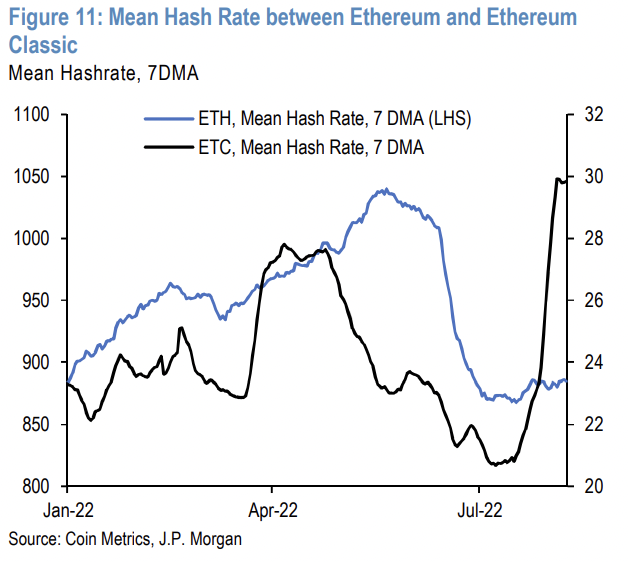
JPMorgan wrote in its weekly fund flows report on Wednesday that Ethereum miners are facing an abrupt change as the merge looms large.  


“As the blockchain shifts from Proof-of-Work, which involves miners solving complex cryptographic puzzles that require extensive computational power, to Proof-of-Stake, where users instead lock up or stake tokens to become validators in the network, the role of miners will effectively end when the transition takes place.” 


JPMorgan, Flows & Liquidity Research Note

The investment bank went on to suggest that Ethereum Classic miners may be the main beneficiaries of Ethereum’s merge as they “would be able to take advantage of second-hand GPUs and ASIC mining rigs sold by ETH miners that instead chose to become validators on Ethereum 2.0.” 

Analysts at the Wall Street firm concluded that there are some signs of a shift to Ethereum Classic already taking place, based on a substantial rise in the hashrate since mid-July. The note said that Ethereum Classic may be seen as a hedge against any potential disruptions in the Ethereum blockchain during the shift.  

Beyond ether, SEBA’s Bernegger said “the longer-term outlook for Bitcoin remains unclear, with flows to risk assets at risk from further rate hikes from the Fed and other central banks due to persistent inflation. Bear markets typically last years, rather than months, and rallies can be a common feature. As such, it’s likely that we will see further volatility before Bitcoin finds a bottom in this period.”

Short-term directional bets dominate ether open interest 

 Ether options open interest recently surpassed bitcoin open interest for the first time and has hurtled past $8 billion to an all-time high, according to The Block Research’s data dashboard.   

Ethereum’s move to proof-of-stake from proof-of-work has a tentative date — despite some miner rebellion — and traders are increasingly speculating on the merge. The aggregate open interest — the value of all outstanding contracts that have yet to settle — of ether options across top-tier exchanges has surpassed $8 billion, up from $7 billion on July 29. 

BlockFi’s global head of trading, Joe Hickey, spoke to The Block on Friday about the move, noting that we are seeing two bullish plays in the market at present:

“The first being an ETH post-merge leveraged play to the upside using calls, butterfly spreads and call spreads.  The second being an ETH fork optionality play by arbitrageurs trading pairs of spot, perpetual and quarterly futures,” he said

LedgerPrime wrote in a Telegram message to counter-parties: “The Long Call Butterfly, which has been the most traded structure for ETH over the last month, has moved this week to the second position, with the Bull Call Spread taking the lead at a volume of 160K.”

A butterfly spread is an options strategy constructed using three different strikes within a single expiration period, made up of all calls, or all puts. The distance between the strikes must be the same. 

The Block spoke about the recent activity in ether options with LedgerPrime’s Laura Vidiella, who said these trades “show directional bets from institutions, as well as retail if we consider Deribit’s volume,” and “at the very least short-term directional bets.” 

According to QCP Capital’s market update on Saturday, ether options open interest eclipsing bitcoin is “unprecedented.”

Earnings watch  

A flurry of crypto-related earnings reports continued apace as bitcoin mining firms logged results and Coinbase shared its earnings on Tuesday.  

Coinbase missed on revenue estimates and cut the top end of its MTU (monthly transacting users) forecast as it saw an underperformance in Q3. Shares in the crypto exchange fell from $97.84 on Monday to $90.49 at the close on Friday. 

Elsewhere, Core Scientific and Hut 8 revealed earnings, with more mining firms set to announce in the week ahead — keep an eye out for Bitfarms on Monday and Canaan on Thursday.  


© 2022 The Block Crypto, Inc. All Rights Reserved. This article is provided for informational purposes only. It is not offered or intended to be used as legal, tax, investment, financial, or other advice.

Go to Source
Author: Adam Morgan McCarthy

The week ahead’s three biggest cryptocurrency stories

It’s safe to say that crypto is one of the most unpredictable financial sectors. Last week, the US Treasury sanctioned crypto mixer Tornado Cash, Blackrock announced its entry into crypto and a tentative date for Ethereum’s transition to proof-of-stake was revealed. 

While it’s hard to imagine what might happen next in crypto, here are the three biggest stories we expect to set tongues wagging next week. 

The fallout from the Tornado

Last week began with the US Treasury making its first ever move against open source code by sanctioning wallets associated with Tornado Cash, a crypto mixer that makes it possible to conceal the origin and destination of cryptocurrency transfers. 

While the initial move was widely criticized in crypto circles, by Friday this had amplified with the announcement that the Dutch Fiscal Information and Investigation Service had arrested a Tornado Cash engineer — later revealed to be Alexey Pertsev. 

Next week could see more legal action. The Dutch authorities have not ruled out further arrests and Pertsev’s wife is currently working with lawyers, she told The Block. A decentralized autonomous organization (DAO) associated with the sanctioned crypto mixer was also discussing ways in which it might challenge the US sanction in the wake of the arrests before its governance forum was taken down. It is unclear whether a legal fund that it discussed will come to fruition. 

Hold on for Hodlnaut

Monday also saw Hodlnaut become the latest crypto lender to halt withdrawals, following Celsius and BlockFi. 

The firm cited recent market conditions for the move and said that it needs to “focus on stabilizing our liquidity and preserving assets”. It also said that it withdrew its application for a license with the Monetary Authority of Singapore (MAS). 

Other embattled crypto lenders such as Celsius have filed for Chapter 11 bankruptcy, while BlockFi struck a credit deal with FTX.US in July, outlining a path to acquisition. 

While it is not yet known what might be the next step for the crypto lender, the situation should become clearer on August 19, when we may get a previously-promised update on the situation.  

Gearing up for the merge

On Thursday, Ethereum core developers earmarked tentative dates for the merge, a process that will see the blockchain transition from proof-of-work to proof-of-stake. This follows Wednesday’s news that Ethereum has passed the final test for proof-of-stake merge on Goerli, paving the way for the merge proper. 

While currently expected to occur in mid-September — on the 15th or 16th — it’s possible that the dates could be tweaked due to block times and hash rate fluctuations. It’s likely that this will become clearer in the coming days and weeks. 

The switch faces opposition from some members of the Ethereum community. There are reports of a miner-led hard fork of the blockchain to maintain the PoW status quo. Those at the heart of this movement said on Friday that an ETHPoW chain was inevitable and that the fork may happen at the same time as the merge. 

The week ahead may also see more exchanges clarify how the merge might affect derivatives tied to ether. On Tuesday, crypto spot and derivatives exchange FTX notified users that derivatives markets tied to ether (ETH) will remain unaffected prior to the merge. 

© 2022 The Block Crypto, Inc. All Rights Reserved. This article is provided for informational purposes only. It is not offered or intended to be used as legal, tax, investment, financial, or other advice.

Go to Source
Author: Tom Matsuda

Aggregate open interest of ether options hits all-time high

Open interest of ether options has hit a fresh all-time high.

Per The Block’s data dashboard, August 12 saw open interest hit $8.11 billion—a figure that’s nearly three times higher than where it stood a month ago. 

The surge in open interest of ether options appears to be tied to the emergence of new, more complex strategies, among traders positioning themselves ahead of Ethereum’s transition from proof-of-work to proof-of-stake, according to hedge fund LedgerPrime. That transition is expected to finalize next month. 

In a Telegram message to counter-parties, LedgerPrime wrote: “The Long Call Butterfly, which has been the most traded structure for ETH over the last month, has moved this week to the second position, with the Bull Call Spread taking the lead at a volume of 160K.”

Meanwhile, open interest of bitcoin options has been slumping for months, currently sitting around $5.5 billion. 

Ether itself is up over 16% on the week amid a broad rally in cryptocurrencies. Open interest of ether futures is also on the rise, approaching levels not seen since early April and topping $9.15 billion. 

© 2022 The Block Crypto, Inc. All Rights Reserved. This article is provided for informational purposes only. It is not offered or intended to be used as legal, tax, investment, financial, or other advice.

Go to Source
Author: Kollen Post


Follow by Email
Facebook20
Pinterest20
fb-share-icon
LinkedIn20
Share